
LHCb explores new light-ion territory with special LHC runs
In summer 2025, the LHC entered new territory. For the first time, the machine delivered proton–oxygen, oxygen–oxygen and neon–neon collisions to its experiments, as part of a short but technically demanding special ion run. For LHCb, the run provided a rare opportunity to explore heavy-ion physics in the forward region with new light-ion systems, extending the experiment’s programme beyond the familiar proton–proton, proton–lead and lead–lead configurations.
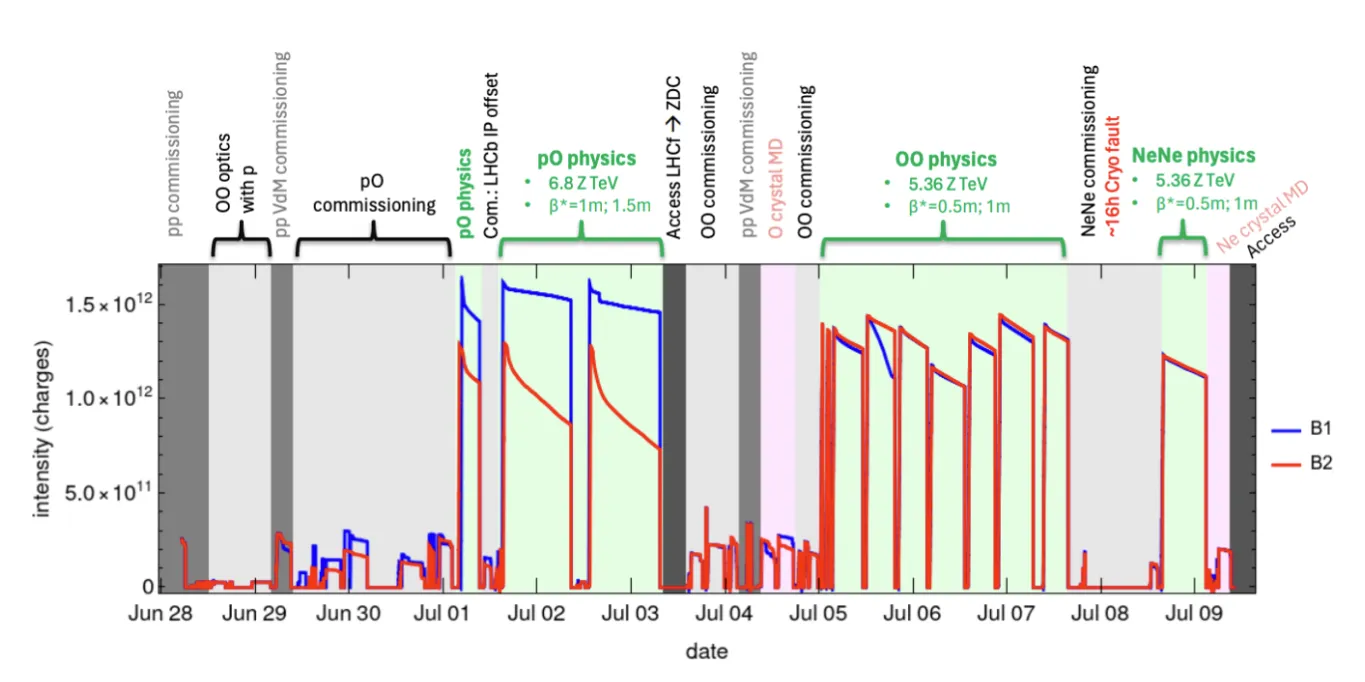
Figure 1: Overview of the 2025 LHC special light-ion run. Timeline of the p–O, O–O and Ne–Ne running periods, including commissioning, luminosity scans, physics fills, and machine development activities. The figure illustrates the rapid transitions between three non-standard LHC configurations and the successful delivery of physics data despite the compressed schedule.
The outcome was highly successful. LHCb had requested 2 nb−1 of integrated luminosity in p–O and 0.5 nb−1 in O–O. By the end of the run, the experiment had collected approximately 33 nb−1 in p–O and around 5.5–5.75 nb−1 in O–O, exceeding its original targets by more than an order of magnitude. A shorter Ne–Ne period also surpassed expectations, delivering about 0.6 nb−1 to LHCb against a target of 0.1 nb−1. These preliminary luminosity numbers, pending final calibration, underscore both the LHC’s performance and the efficiency of the LHCb data-taking strategy.
The p–O part of the run posed particular challenges. Protons and oxygen ions have different charge-to-mass ratios and therefore different revolution frequencies in the LHC. To bring the two beams into collision, the machine used a special configuration in which the beams were injected and ramped with the same magnetic rigidity but different revolution frequencies. At top energy, the frequencies were locked, the beams were shifted into collision through a procedure known as cogging, and collisions were produced with the beams slightly off-momentum.
For LHCb, the resulting p–O sample is especially valuable. Proton–oxygen collisions provide an asymmetric system involving a light nucleus, offering a clean way to study how ordinary nuclear matter affects particle production. In the forward region covered by LHCb, such measurements are complementary to those of the central LHC experiments and are relevant for studies of heavy-flavour production, quarkonia and other probes of nuclear effects.
The p–O running conditions were also shaped by the needs of other experiments. In particular, LHCf required very low pile-up conditions, which constrained luminosity delivery at ATLAS/LHCf. LHCb, by contrast, was able to profit from favourable data-taking conditions and accumulated a dataset far beyond the original request. The luminosity evolution during the p–O fills shows how quickly the run moved from commissioning into physics production, with two long physics fills delivered over roughly two days after the inclusion of an LHCb interaction-point offset.
The O–O period offered a different perspective. Unlike p–O, oxygen–oxygen collisions are symmetric, but much lighter than lead–lead collisions. They therefore provide an important testing ground for understanding how collective behaviour emerges as the size of the colliding system changes. The O–O run was performed at 5.36 Z TeV, matching the energy requested for comparison with proton–proton reference data, and the optics were squeezed to increase the available luminosity.
The O–O run also brought a new beam-physics consideration. Oxygen–oxygen collisions can produce nuclear fragments with the same mass-to-charge ratio as the original beam. Some of these fragments can remain circulating, gradually producing a small contamination of the beam by other ion species. Although simulations indicated that this effect should remain well below 1% of the total integrated luminosity, it had not previously been observed at the LHC. As a precaution, O–O physics production was divided into fills of about six hours.
In practice, the O–O run was highly efficient. The LHC delivered seven back-to-back physics fills between 5 and 7 July. A single six-hour fill would already have been sufficient to reach LHCb’s nominal luminosity target, but excellent machine availability allowed data taking to continue for around 2.6 days. This brought the LHCb O–O sample to more than eleven times the original request.
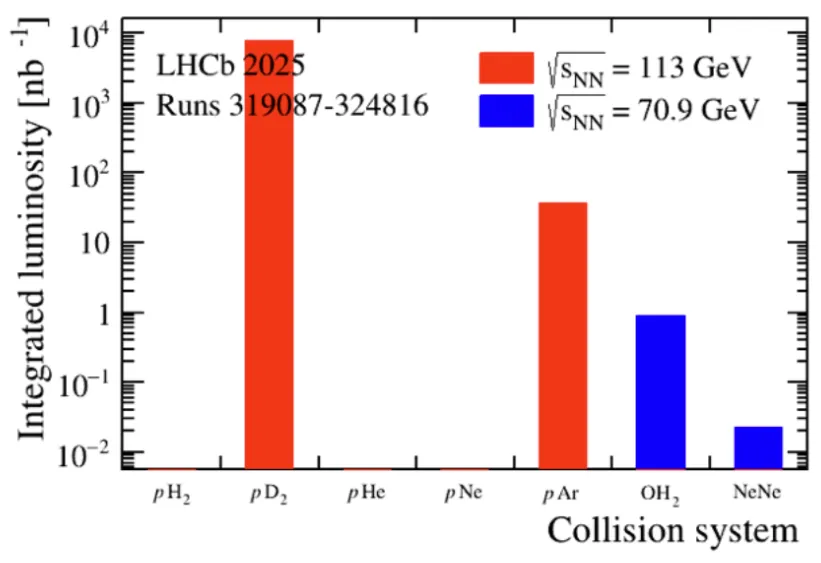
Figure 2: LHCb luminosity accumulation across Run 3 light-ion and fixed-target samples. Recorded and integrated luminosities are shown for several LHCb collision systems, including the 2025 special light-ion run. LHCb far exceeded its initial targets for the special run, recording approximately 33 nb−1 in p–O, 5.5 nb−1 in O–O and 0.56 nb−1 in Ne–Ne collisions. These datasets provide the basis for new studies of heavy-flavour production, nuclear effects and collective behaviour in light-ion systems.
Early signals already illustrate the potential of this dataset. Reconstructed beauty and charm mass peaks measured in O–O collisions demonstrate LHCb’s ability to identify heavy-flavour particles in this new collision system. Such measurements will allow the experiment to investigate how charm and beauty production are modified in light-ion environments, complementing previous studies in proton–proton, proton–lead and lead–lead collisions.
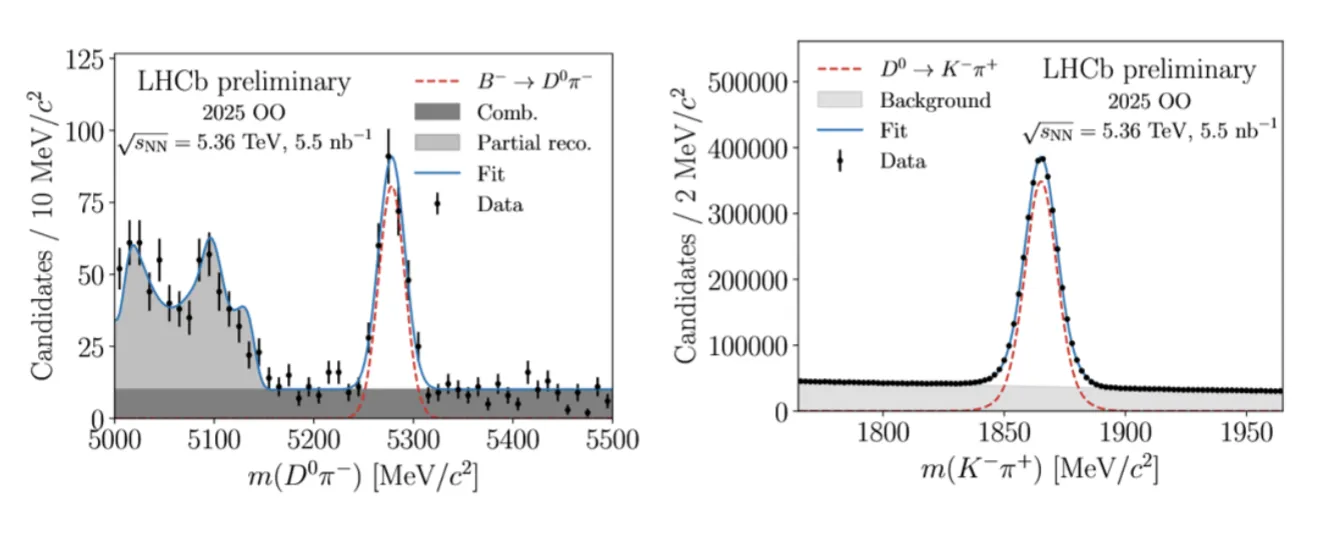
Figure 3: Reconstructed mass peaks of beauty and charm hadrons measured by LHCb in oxygen–oxygen collisions. These first signals demonstrate the potential of the 2025 O–O dataset for heavy-flavour studies in light-ion collisions.
The 2025 special run also fits into a broader LHCb heavy-ion strategy. Thanks to SMOG2, the experiment can inject gases into the LHC beam pipe and record fixed-target collisions alongside standard collider-mode data. This capability is unique among the LHC experiments and has allowed LHCb to study a wide range of collision systems during Run 3.
A recent LHCb analysis using fixed-target PbNe and PbAr collisions at √sNN = 70.9 GeV illustrates the scientific reach of this programme. The analysis measured anisotropic flow coefficients using multiparticle cumulants and compared collisions involving neon with those involving argon. The elliptic-flow coefficient v2 was found to be significantly larger in central PbNe collisions than in PbAr collisions, by about a factor of 1.4 in the most central events. This behaviour is qualitatively consistent with hydrodynamic predictions that include nuclear-structure inputs, and points to the distinctive “bowling-pin” shape expected for the ground state of the 20Ne nucleus.
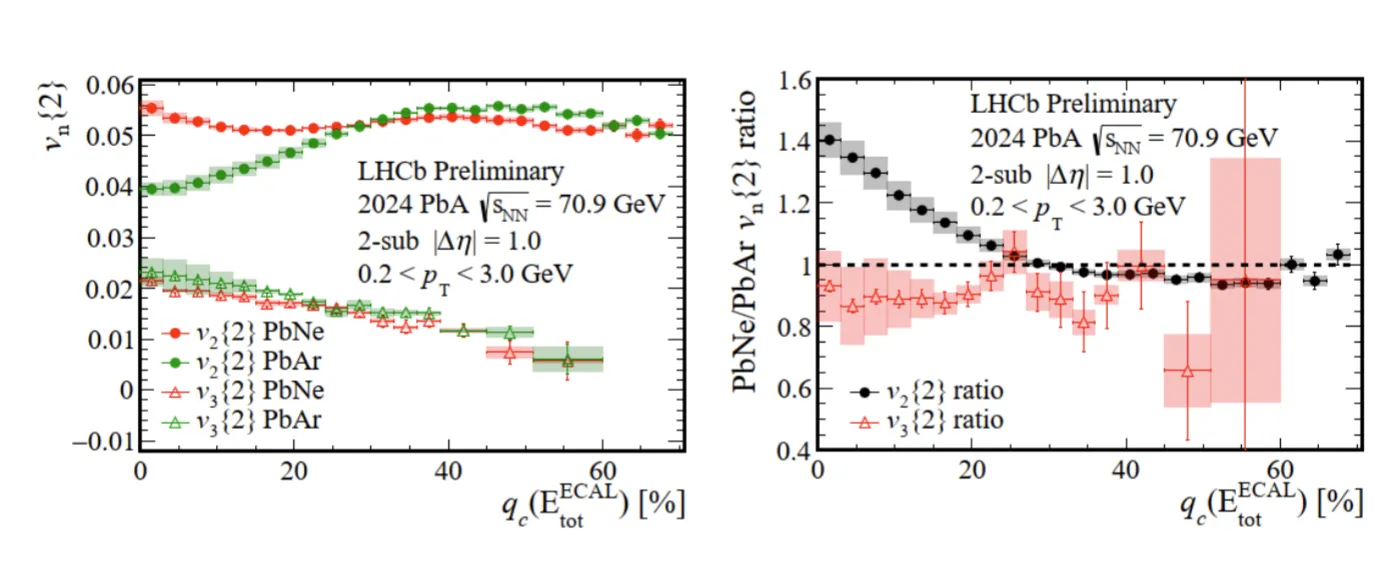
Figure 4: The images above show the distribution of the v2 and v3 flow coefficients as a function of centrality (left), alongside the ratio between PbNe and PbAr collisions (right). The flow coefficients demonstrate a distinctly different dependence on centrality in PbNe and PbAr collisions. Notably, v2 in PbNe collisions is 1.4 times larger than in PbAr for the most central collisions. This non-trivial dependence is well described by hydrodynamic models that incorporate nuclear-structure inputs. This points to a clear signature of the peculiar bowling-pin shape of the 20Ne nucleus and supports the use of hydrodynamic descriptions for the hot medium formed in these collisions.
This result shows how high-energy nuclear collisions can act as a form of nuclear imaging. The initial shape of the colliding nuclei can leave measurable traces in the momentum distribution of the particles produced. Flow coefficients such as v2 and v3 quantify these anisotropies, providing information both on the initial nuclear geometry and on the collective response of the medium created in the collision. Light-ion systems such as O–O and Ne–Ne therefore offer a way to test how nuclear structure and collective dynamics are connected, and how far hydrodynamic descriptions can be extended beyond large heavy-ion collisions.
Although the 2025 Ne–Ne collider period was short, it adds an important element to this broader programme. The switch from oxygen to neon was completed rapidly, with the first neon beam injected into the LHC about eight hours after the source switch, although a cryogenics fault delayed physics production. Only one Ne–Ne physics fill was delivered, but it still exceeded the LHCb luminosity target. Together with the fixed-target PbNe results, this first Ne–Ne collider sample strengthens LHCb’s growing light-ion physics programme.
LHCb brings a distinctive contribution to these studies. Its forward geometry gives access to regions of phase space that complement the central LHC detectors, while SMOG2 allows the experiment to combine collider and fixed-target data in a way that is unique at the LHC. The 2025 special light-ion run adds important new collider-mode datasets to this expanding programme.
Taken together, the run was a remarkable demonstration of what can be achieved in a tightly constrained machine schedule. The LHC operated three special configurations in rapid succession, including collision systems never before delivered at the collider. For LHCb, the outcome is especially promising: sizeable p–O and O–O datasets in the forward region, a first Ne–Ne collider sample, and a growing fixed-target light-ion programme.
The next stage will belong to the analyses. The machine has delivered the data; LHCb can now begin to turn these special collision samples into physics results, exploring how particle production, nuclear structure and collective behaviour evolve across some of the lightest ion systems ever studied at the LHC.
Read more:
Special light-ion LHC runs: https://lhcb-outreach.web.cern.ch/2025/09/22/special-light-ion-lhc-runs/