
August 2013
Editorial – August 2013
The Summer Student program is well known and is a great success thanks to the dedication of CERN staff and of the numerous teachers from our community who contribute to an excellent series of lectures. What is probably less well known is that, following the strong involvement of pioneers such as John Ellis (interviewed by students in this issue) and thanks to the financial contribution of several countries and foundations, the number of Non-Member States students has grown almost at the same level as for Member States. Needless to say that it creates a fantastic “melting pot” of different cultures at CERN, which offers a unique experience for the students. This is well reflected in the (sometimes quite original) reports by students that you will find in this Newsletter.
In a similar way, the High Energy Physics Schools, organized by CERN in collaboration with various institutes, have also crossed the borders of Europe, as you will see in the dedicated article. Let me stress the essential role of the PH department in the organisation of these schools.
Finally, you will also find several articles about the EPLANET program, or its predecessor HELEN, funded by the EU, which is fostering a strong collaboration between Latin American countries, CERN and some other European states.
I hope you will enjoy reading this large amount of material collected during the Summer. Please do not hesitate to signal this Newsletter to our outside collaborators.
Philippe
EPLANET: The European Particle physics Latin America NETwork
Communication
Collaboration
Education
These concepts are fundamental to the advance of science. Science thrives when scientists collaboratively conduct and publish research, when they are able to communicate easily, when the young generations have unrestricted access to university education. The EPLANET Programme advocates the above mindset. The Programme allocates funds to Latin American and European scientists from the HEP field, especially young scholars, to visit European and Latin American research institutions respectively. It aims to establish bridges of communication and consolidate the collaboration between the Latin American and the European HEP community as well as provide advanced training to young researchers.
HELEN and the beginning of EPLANET
The story of EPLANET begins with the HELEN project. In 2003 the HEP field had started to advance and, as the plans for the LHC were afoot, it showed enormous potential. Latin America already had a long physics tradition, involving prominent scientists such as Giambiagi, Lattes, Lopes, Moshinsky and Vallarta to name but a few. The need to join forces with the European HEP community, which had well developed infrastructure and considerable scientific knowledge, was apparent. Luciano Maiani, former CERN DG, and Juan Antonio Rubio were the first to realize the importance of a Latin American- European collaboration and they decided to launch a project that would address these concerns. They also received the invaluable support of Veronica Riquer. She arrived at CERN in 2003 and became involved in the project almost immediately. Her connections in the Latin American HEP community proved extremely useful. The outcome of their collaboration was the project HELEN, i.e. the High Energy Latin American European Network, that was approved in 2005 and was funded by the European Commission. The countries that participated in HELEN were Mexico, Chile, Brazil, Argentina, Colombia, Cuba, Venezuela and Peru. The principal aim of the project was to train the new generation of Latin American physicists, with a focus on HEP, and build a stable relationship with the European HEP community. The project provided scientists from Latin America with the funding to visit Europe, mainly CERN, for further education and research.
Physicists from Europe also travelled to Latin America, mainly to the Pierre Auger Observatory, an international cosmic ray observatory located in Argentina. In addition, 15% of the budget was dedicated to visits from professors in the network, to give seminars, oversee students and start new collaborations. However, the real novelty of HELEN was that it allowed perhaps for the first time students and young researchers from Latin American countries to participate, thus focusing on the new generation of scientists. Before, only the acknowledged scientists could obtain funding from their governments. Altogether, HELEN was a successful project, as it facilitated the signature of MoU's between LHC experiments and Argentinian and Chilean Institutions and of Cooperation Agreements between CERN and the Governments or funding Agencies of Argentina, Brazil, Chile and Mexico.
When HELEN finished in 2009, after four years of successful running, the need for a similar programme was apparent. Unfortunately, it was no longer possible to receive funding from the European Commission. After some research, Maiani, Rubio, Riquer worked with Paolo Giubellino and Jose Salicio Diez to write a proposal for a similar project called EPLANET and submitted it to the 7th Framework Programme – Marie Curie People, which approved it.
Paolo Giubellino states: “EPLANET is actually the continuation of the HELEN program, which was the first organized effort to promote the collaboration between European and Latin American High Energy Physicists. The two programs, both led by Prof. Luciano Maiani, have been tremendously successful, and one can really divide history of science in Latin America in a before, essentially oriented to collaborating with US institutions, and an after, in which collaboration with Europe in general and with CERN in particular has flourished. I have always believed in the enormous potential of LA science, and indeed the LHC experiments and ALICE in particular have progressively grown to have very strong and highly qualified LA participation.”
Overview
EPLANET was launched in February 2011 and it is programmed to run for 4 years, until 2015. During its lifetime it is going to offer 379 grants for visits to Europe which means that researchers for Latin America will be able to spend in total 1203 months working with their colleagues at CERN. Moreover 476 grants are given for visits to Latin America countries (600 months) offering some training in new technologies and computing techniques as well as working on the analysis of the physics results. Altogether, 12 European Institutions from six countries (Italy, France, Switzerland, Portugal, UK and Spain) (tables 1,2) and 18 Latin American Institutions from four countries (Argentina, Chile, Brazil and Mexico) (table 3) participate in the programme.
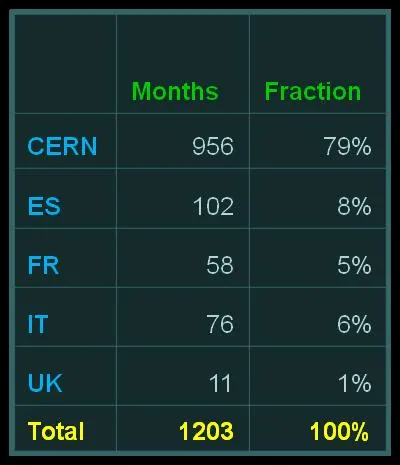
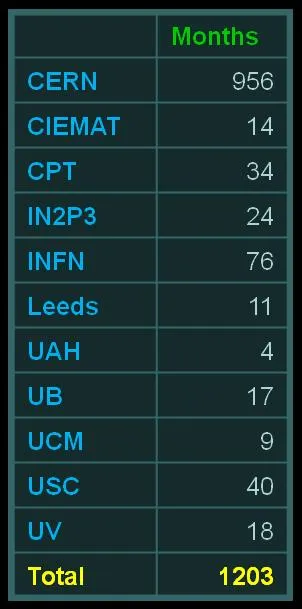
Tables 1 and 2 showing the participation of European Institutes in EPLANET and the number of months that researches have spent in various laboratories around Europe.
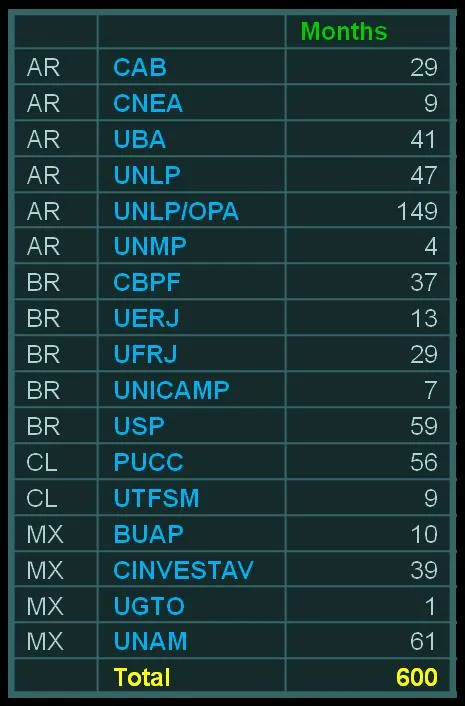
Table 3: The number of months that researchers from European institutes spent in Latin-American countries as part of the EPLANET project.
From these figures one can clearly see that EPLANET is giving to many scientist from LA the opportunity to exploit the analysis of the LHC data and to benefit from the contacts and discussions with world wide scientists
CERN contributes to EPLANET with 108 months of personnel detached to LA Institutions during the 4 years of operation. Although the participation during the first year of the program was quite low, mainly due to the long break between HELEN and EPLANET, it rapidly increased reaching today almost 65% of the planned value. Of course, further efforts are needed to improve the number of detachments in the coming years.
Objectives
Research carried out at a national level often suffers from fragmentation, isolation and compartmentalization. Particularly, in HEP, an extremely complex field, international collaboration in the form of scientist exchanges has proven to be the most effective method for the transfer of knowledge and the training of new physicists. EPLANET aims to foster a sustainable collaboration and strengthen the existing research partnership between Latin America and Europe as well as provide advanced training in the various applications of HEP. Secondary objectives include promoting internal Latin American collaboration and international collaborative research projects. Within this framework, the programme will finance academic exchanges of Early Stages Researchers and Experienced Researchers to various research institutes, mainly CERN in Europe and the Pierre Auger Observatory in Latin America. As a result, the Latin American physicists will be granted access to the best experimental facilities in Europe and acquire technical expertise which will enhance the discovery potential and improve university education in their countries. Moreover, the Latin American community will take advantage of the existing technologies to promote industrial innovation, raising its scientific visibility. As for the European physicists, their contact with another scientific culture will broaden their scope and result in a fresh approach to science.
Work Packages
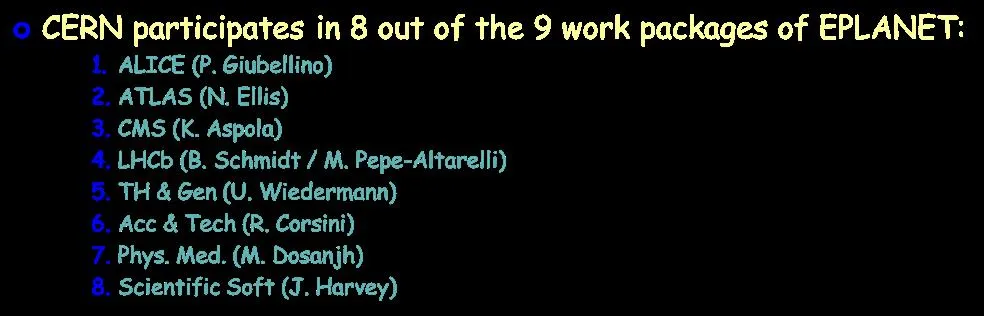
The Programme focuses on the LHC experiments (ALICE, ATLAS, CMS, LHCb), the Auger experiment, particle physics theory, medical applications of particle physics, accelerator technologies and scientific computing, which constitute nine work packages. European senior researchers will be detached to Latin America for short periods of time (1-2 months) in order to improve the educational system and contribute with their knowledge and experience to the training of young scientists. Junior researchers will go on long term exchanges (2-12 months), therefore they will have the opportunity to gain valuable in depth experience of the work in large scientific projects.
At CERN, Latin American researchers will participate in the selection, processing and analysis of data taken from the LHC experiments, develop software for HEP experiments, design prototypes of detectors for medical physics, address Standard Model problems, take part in the R&D and much more. The expected deliverables include software releases, scientific publications, detailed reports on experimental results and deployment of computing services. In addition, workshops on every Work Package will be organized, helping the participants of EPLANET share their ideas and experiences and further explore the topic of each WP.
Naturally, special emphasis is placed upon assimilating newcomers into the physics collaborations and they will be encouraged to participate in collaboration meetings, present reports of their work and take part in outreach programmes and other activities.
CERN Resources
As the recipient of a large fraction of the Latin American grants (79%), CERN provides resources to administer and manage the project. Administrative personnel from the various experiments and activities involved in the 8 work packages help the grantees to find their way at CERN. This includes their reception, their registration, the monthly payment of the grant, the collection of reports, etc. Notably, K. Ross, the secretary of the Head of the PH Department constitutes the point of reference for the administrative personnel and for the scientists coming to CERN, collecting and handling the various documents needed to write the reports and justifications required by the scheme IRSES. C. Hervet, K. Richardson, K. Aspola, A. Yaneva, N. Grub, M. Connor, G. Hobgen, K. Ross, U. Tihinen and T. Pardo, are handling the daily administration of the corresponding work packages.
CERN provides not only the administrative support for the work packages but also a few scientists from CERN, P. Giubellino, N. Ellis, K. Aspola, B. Schmidt, M. Pepe-Altarelli, U. Wiedermann, R. Corsini, M. Dosanjh and J. Harvey, are coordinating each of the 8 work packages where CERN is involved. The coordination of the work packages is fundamental to achieve the objectives that have been defined in each, in terms of tasks, deliverables and milestones.
In addition to the 108 man-months that CERN fulfills sending scientists to Latin America to teach and help our colleagues in the various activities related to the work packages; CERN also provides a few direct grants to scientists from institutions of Colombia, Peru and Venezuela. These countries, which were included in HELEN, could not be accommodated in EPLANET due to the missing Science & Technology agreement with the European Commission. However, scientists from these countries are active in various experiments at CERN. In particular, Colombia participates in ATLAS and CMS, Peru in ALICE and Venezuela in ATLAS. The grants given by CERN should follow the same rules as those established for EPLANET. On this way, the scientists from these countries could be considered as being part of the project.
Results
As of 2013 EPLANET has been running for two years. It has continued the success of HELEN, as the large number of work reports and publications indicate that the objectives mentioned in the original proposal have been accomplished. The presence of Latin American scientists at CERN has been increased considerably. The participants of EPLANET have also contributed significantly to the discovery of the Higgs-like boson, the new particle identified by ATLAS and CMS. In addition, the Programme has resulted in close collaboration between European and Latin American groups.
There is still a long way to go but important steps towards improvement have been made.
As Luciano Maiani puts it: “I would like to see some of the countries that participate in the project developing stable relationships with CERN. This means stabilization of the financial support for HEP research in these countries. HELEN and EPLANET have proved to the governments that with solid support many things can be done.”
EPLANET – Meet some of the participants
We met five Latin-American physicists during their recent stay to CERN and asked them to share their experiences from the EPLANET programme and their future plans…
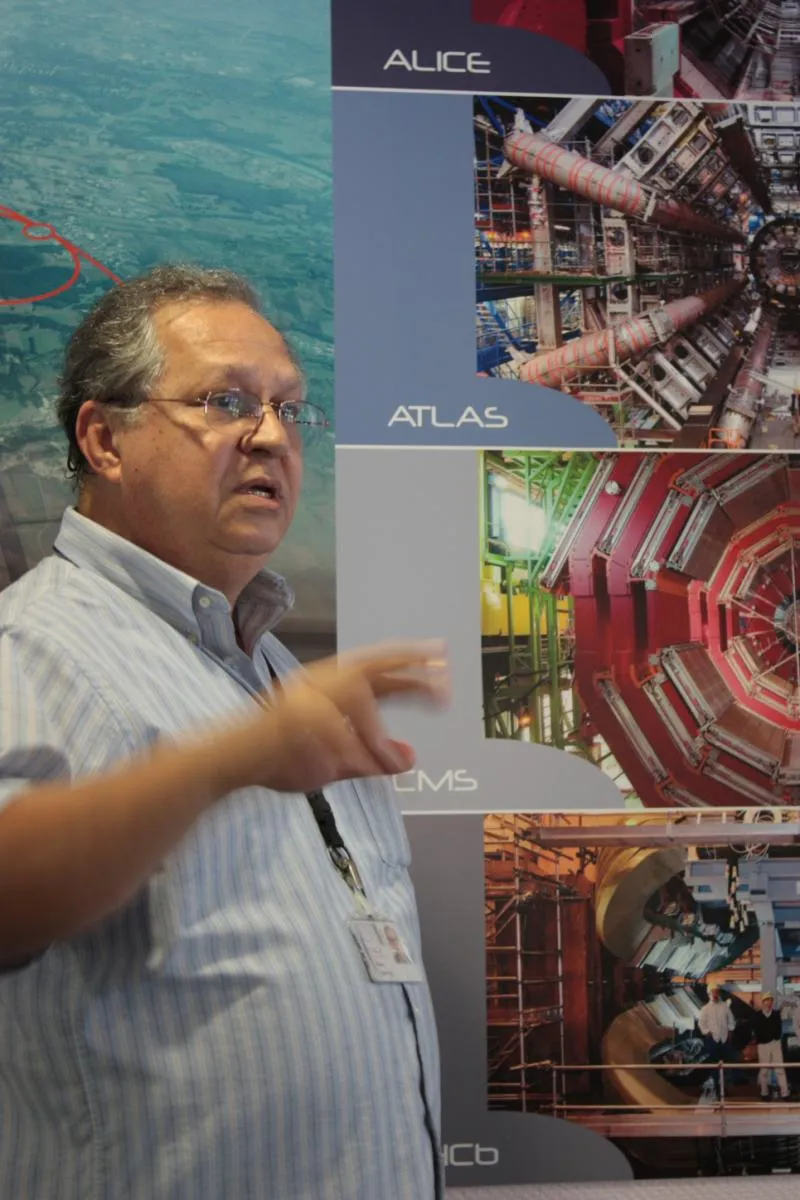
“Following our participation on the HELEN program program we decided to participate following the initiative of Luciano Maiani. We thought this program as a natural continuation of our previous collaboration with Maiani.
First of all, amongst our future plans is to increase our contribution to the High Energy Physics community. As a consequence of this project we have a higher presence at CERN working directly in the experiments. I believe sincerely that this program have to continue and open to more participants. For example in Brazil the program "Science without Borders" has recently been established by the government, addressing scientists at different levels of their carreer: from undergraduate student to PhD graduates and Senior Researchers. This is very important because it gives from a very early stage the opportunity to young scientists to visit laboratories like CERN. As you probably know, EPLANET doesn't support grants for undergraduate students.I think that the program should continue for many years and I hope that it will be possible to consolidate the Latin American Groups. “
Alberto Santoro, UERJ, Brazil
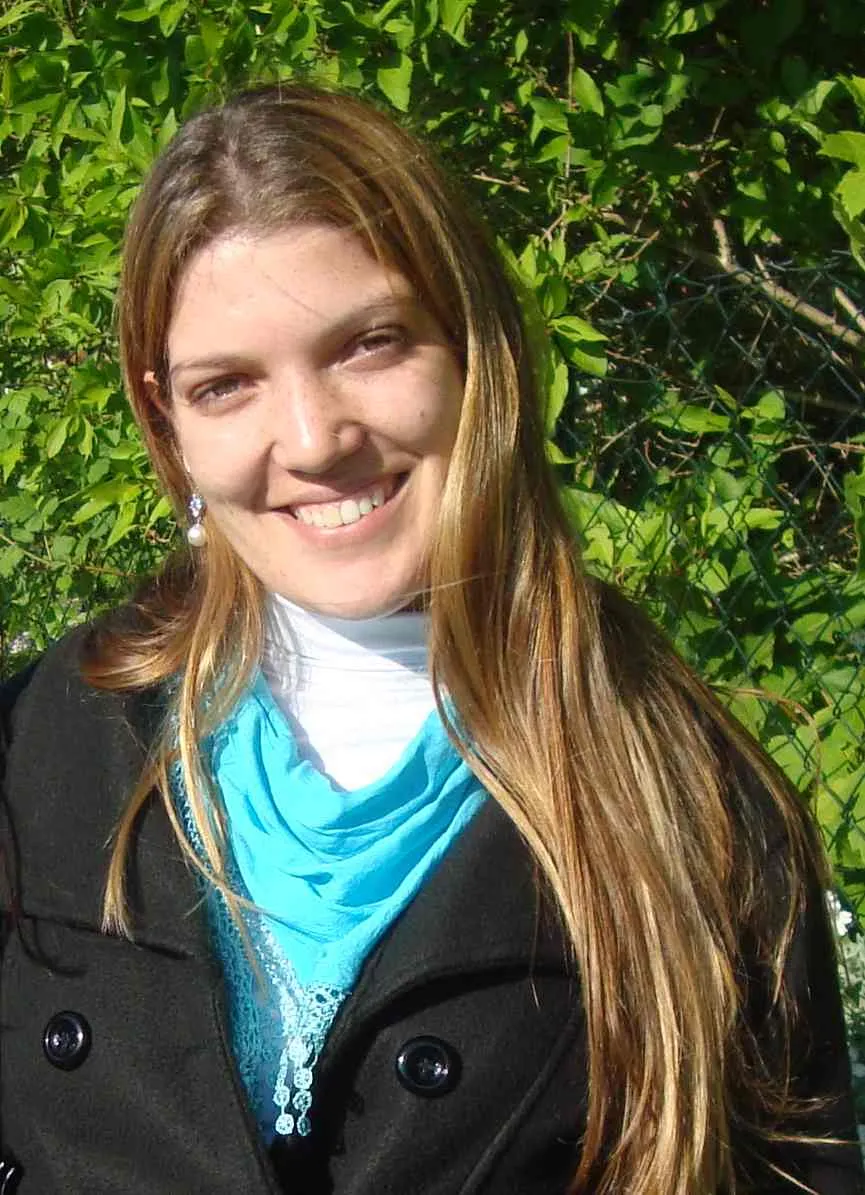
“My name is Cristiane Jahnke and I am a PhD student from Sao Paulo, Brazil. I am here at CERN with an EPlANET fellowship for three months. I arrived on the 1st of April and I will stay until the 28th of June.It was my first time at CERN. I knew about the programme since my supervisor from Brazil is a Team Leader of the ALICE collaboration. My research is with ALICE Collaboration, where I am working on Electron Spectrum from heavy-flavor, in p-Pb data. It is very nice being at CERN, because we can interact with other people who know a lot of high energy physics and learn a lot. I plan to come back to CERN for more 9 months next year.”
Christiane Jahnke, PhD student, University of Sao Paolo, Brazil
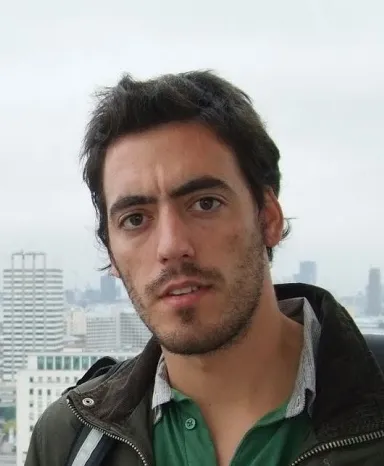
“I had the chance to be part not only of EPLANET, but also on the former HELEN programme. My involvement with CERN started back in 2006 as an undergraduate student, and thanks to both HELEN and EPLANET. I've been able to come to CERN several times during my PhD period. My thesis work (2007-2012), done in the context of both EPLANET and HELEN, consist mainly in the search for extra dimensions on the ATLAS experiment. Theories beyond the well established Standard Model postulate the existence of extra dimensions, which would manifest by the detection of very energetic particles. With the ATLAS detector it's possible to detect such particles or constrain their existence if not detected. My thesis represent the first search of extra dimensions in the diphoton final state in ATLAS, and we were able to set the most stringent constraints up to then. Now as a postdoctoral researcher I'm working on the measurement of the properties of the recent discovered higgs-like particle. This is one of the most active topics in the field and probably the most fascinating. I would keep working on this for the next years, since 2015 LHC-data would be of great importance for this matter.”
Xabier Anduaga Del Popolo, Post Doctoral Researcher – Universidad Nacional de La Plata.
“ Probably one of most rewarding aspects of being a particle physicist is the opportunity to visit and live all around the world. I certainly had this in mind when I decided to get a Ph. D., and after completing graduate school I knew that working at CERN would be in my future. When I learned about the opportunity to live and work in Chile and do particle physics, I knew that all these long nights in graduate school were really worthy. Two years later I’ve enjoyed both Chilean and European summers while becoming a researchers working with the ATLAS experiment, thanks in large part to the EPlanet programme.
Experimental physics is emerging in Chile due to the strong economy and significant funding from the government for science and technology research and innovation. While Chile is known internationally for hosting the European Southern Observatory in the northern Atacama desert, the country’s experimental research programmes in particle and nuclear physics are rapidly expanding in terms of public awareness and government funding. A significant part of the research is in collaboration with CERN and the ATLAS experiment. The group at Universidad Técnica Federico Santa María now hosts a Tier-2 grid site and has a well-established research programme in Heavy Ion physics. Thanks to the EPLANET programme I managed to establish new research and service roles on the ATLAS experiment.
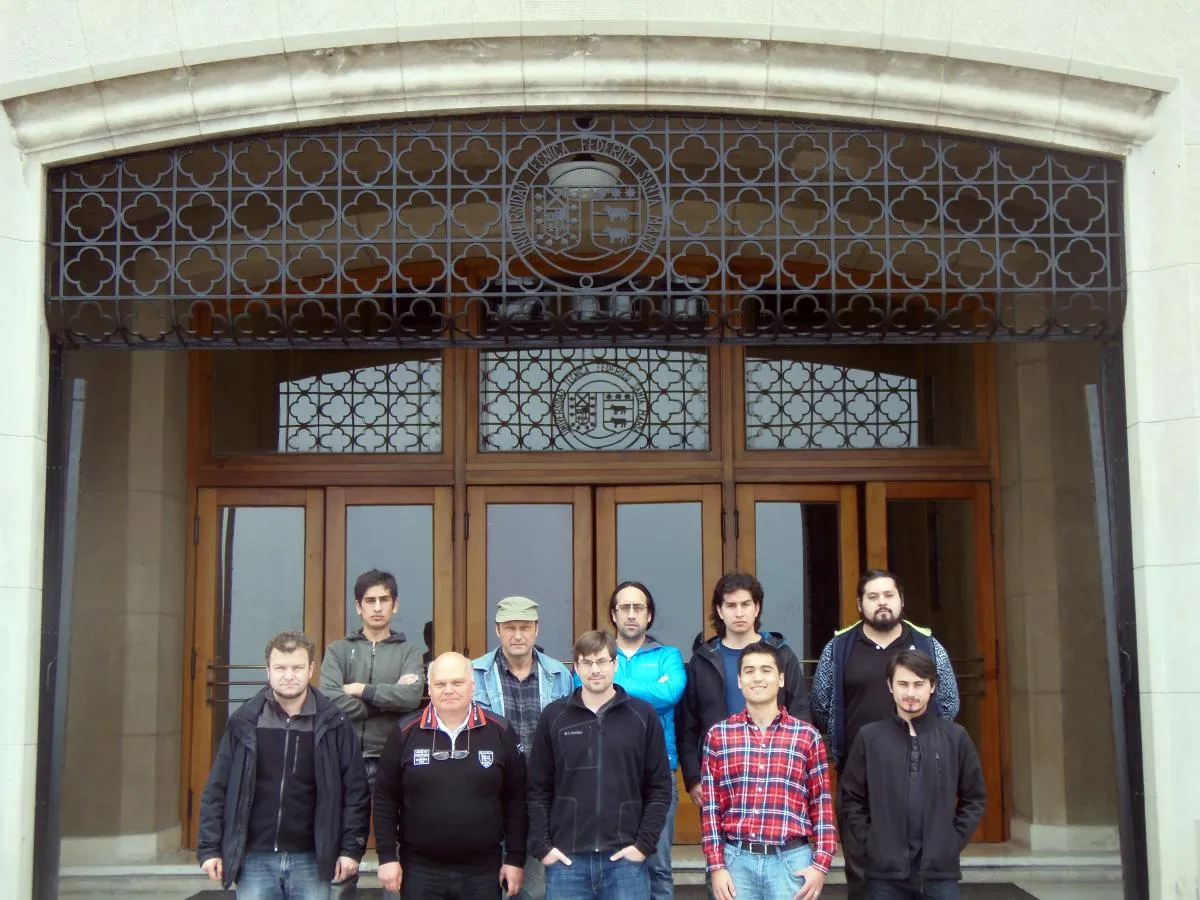
Ryan Machenzie White (in the middle) surrounded by students working in the Heavy-Ions ATLAS trigger.
During the first EPLANET trip, I was ramping up as software coordinator and on-call shifter during 2012 data taking for the electron/photon high level trigger group for ATLAS. During subsequent EPLANET trips, I have focused on software development with the electron/photon trigger group in preparation for the 2015 data-taking. I enjoy the opportunity to work with experts in electron/photon reconstruction, the trigger menu group and core software developers. Each trip I return to Chile with more opportunities for students, who want to become involved in experimental particle physics, to conduct research in the ATLAS trigger community. I am working with a graduate student, studying the effect of pileup on the calorimeter shower shapes that are used to identify photons in the high level trigger.I look forward to an EPLANET trip in the near future with Chilean students and postdocs. The EPLANET programme is providing the opportunity to build an ATLAS research group in a society that could not have considered funding scientific and technological research at this level a decade ago.”
Ryan Mackenzie White, Universidad Técnica Federico Santa María, Chile
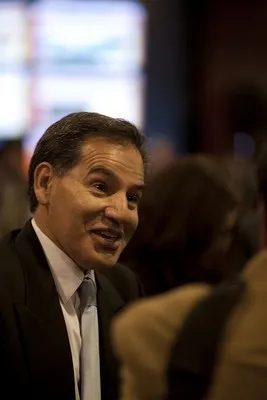
The HELEN programme was crucial for our group during the installation phase of ALICE. Now E-Planet is playing a key role for the consolidation of our participation in the ALICE collaboration. The weakness of our research groups in Mexico is the lack of continuity in financial support. The changing conditions of our economies as well as the political uncertainties have always affected research groups which are part of long term projects.
In that sense, E-Planet has been able to give us assurance. We have now presence in the projects of which we are in charge.We used to live in uncertainty and “planing” has ben alsways a luxus in Latin America. E-planet is working the miracle of “planing” in our community.
Gerardo Herrera Corall, CINVESTAV, Mexico
Interview with Luciano Maiani and Veronica Riquer
How did you become involved with the EPLANET project?
L.M. When I was Director General I happened to discuss the future of Latin America with Juan Antonio Rubio. He convinced me that Latin America had endless possibilities for development, especially in the field of particle physics.
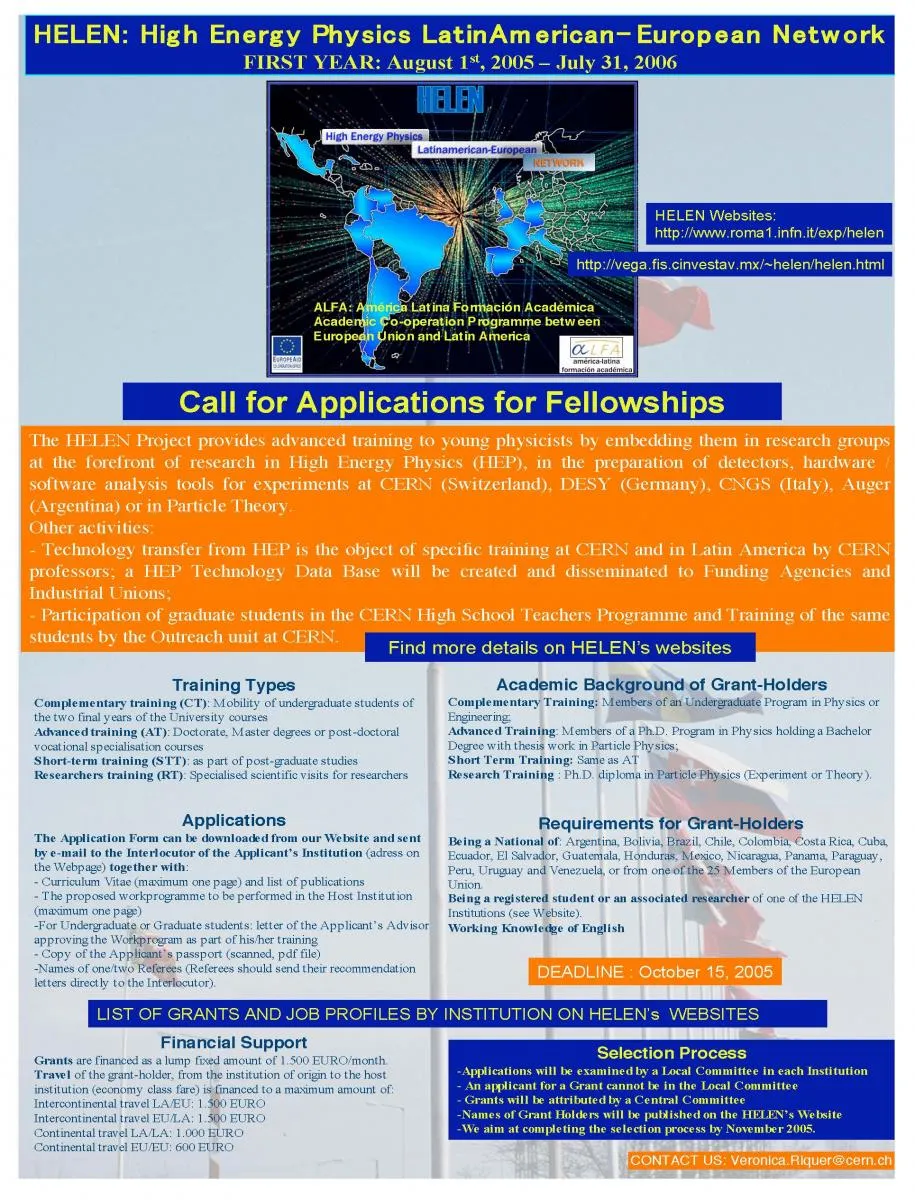
In addition, I noticed that many European scientists participated in the Auger experiment that was set up in Argentina in 2001. It occurred to me that the LHC and the Auger could constitute the basic elements of a Latin American- European collaboration. We discussed this subject with Philip Buscuin, the European Commissioner for research, in 2002 and he mentioned that the European Commission was interested in Latin America. It had launched a project which was called ALFA – that stands for America Latina Formacion Academica. He suggested that we carry out a project for ALFA, therefore I collaborated with Juan Antonio Rubio and Veronica Riquer. The result of our collaboration was project HELEN, i.e. High Energy Physics Latin American- European Network, which was submitted in 2004 and approved in 2005. The Latin American countries that participated in HELEN were Mexico, Chile, Brazil, Argentina, Colombia, Cuba, Venezuela and Peru. The project was a great success and it realized our dream of establishing a bridge between Latin American and European countries. More specifically, this collaboration allowed the exchange of young people. Before HELEN only the acknowledged scientists could get funding from their governments in order to travel abroad. The real novelty that HELEN brought was that even undergraduate students could receive financial support. As a result, a large Latin American community developed at CERN.
V.R. When I arrived at CERN in 2003 I learned that there was an interest to attract the High Energy Physics Community of Latin America to the project of the LHC. LEP had given all these wonderful results and the projects for building the world’s largest hadron collider at CERN were already endorsed. The building of the LHC and the physics potential of the machine were calling for an international collaboration.
Juan Antonio Rubio and Luciano Maiani had already the idea of a project that would encourage researchers and students from Latin America to work at the LHC. I was so excited by their project that I immediately decided to join in. Since I already knew most of the physicists in our field in Latin America I considered this a personal challenge. The project could offer HEP physicists new opportunities for boosting their career. We launched the HELEN project that was submitted in the framework of the ALFA program. I was deeply involved in setting up the network of laboratories and universities that were participating in HELEN and I carried out some of the heavy-administrative work for the project.
You will probably find the story of the submission of the proposal for HELEN to the European Commission quite amusing. The deadline for submitting all proposals was the 30th of April and on the night before I stayed at CERN working till the early morning. Around 07:00am a secretary arrived and offered to travel to Brussels to submit the proposal, as we didn’t have enough time to send it by courier. On top of that, as she was running to catch her flight in the airport she had an accident. Like in one of these action films her suitcase opened and the documents were scattered all over the airport. Thankfully, she managed to collect them and submit the proposal. However, when we received a confirmation from the Commission it stated that “all documents are in disorder”. In the end, the project was approved and the commission agreed to the budget that we had asked for. They realized the importance of this project.
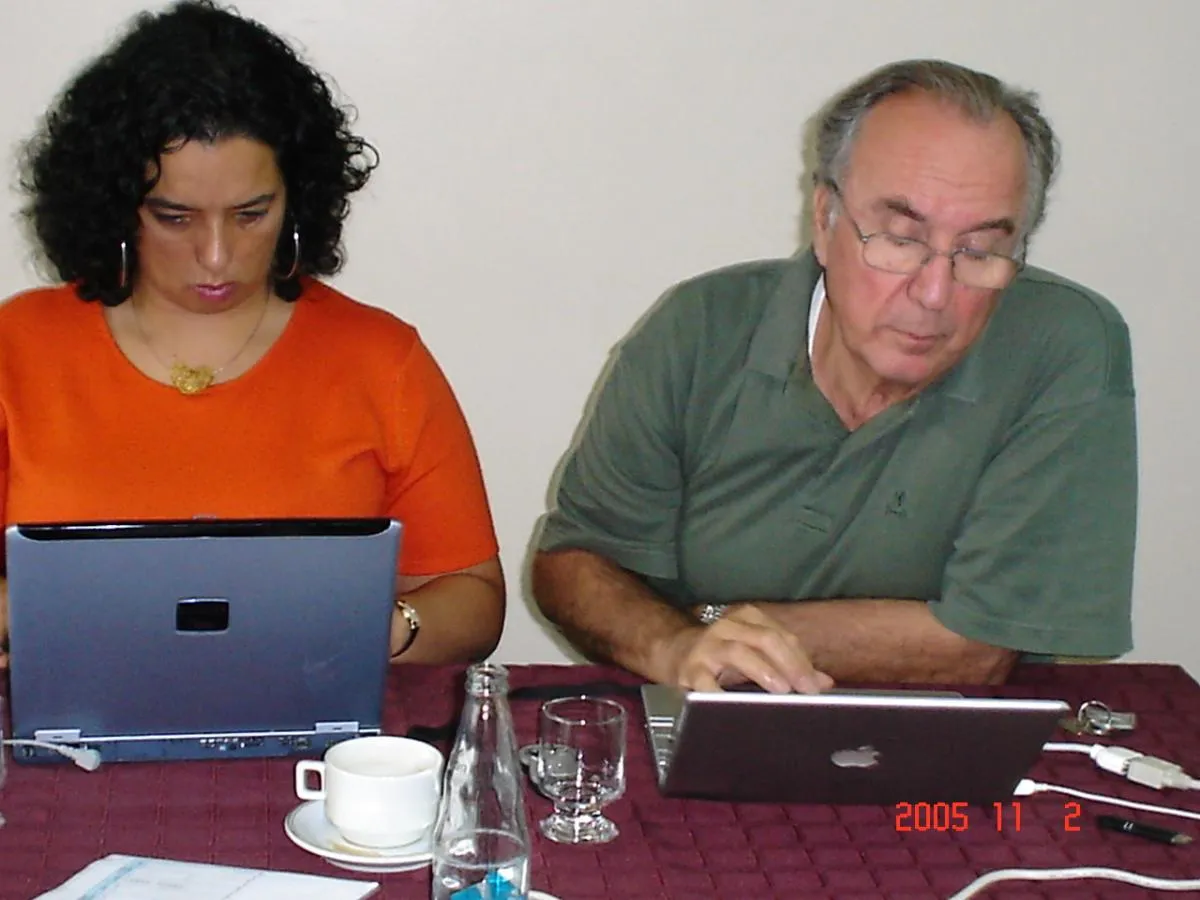
Veronica Riquer and Luciano Maiani during the first Helen’s Executive Board meeting in Rio de Janeiro, Nov., 2005
What were the first contacts that you had in Latin America?
L.M. Juan Antonio Rubio and Veronica Riquer knew essentially everybody in Latin America. The starting point was the CERN Latin American School that was organized by Juan Antonio Rubio in 2001. At the time, there was already a number of people in Mexico, in Brazil and in Argentina that had some connection to CERN, therefore we did not encounter singnificant problems in having people associating with this enterprise.
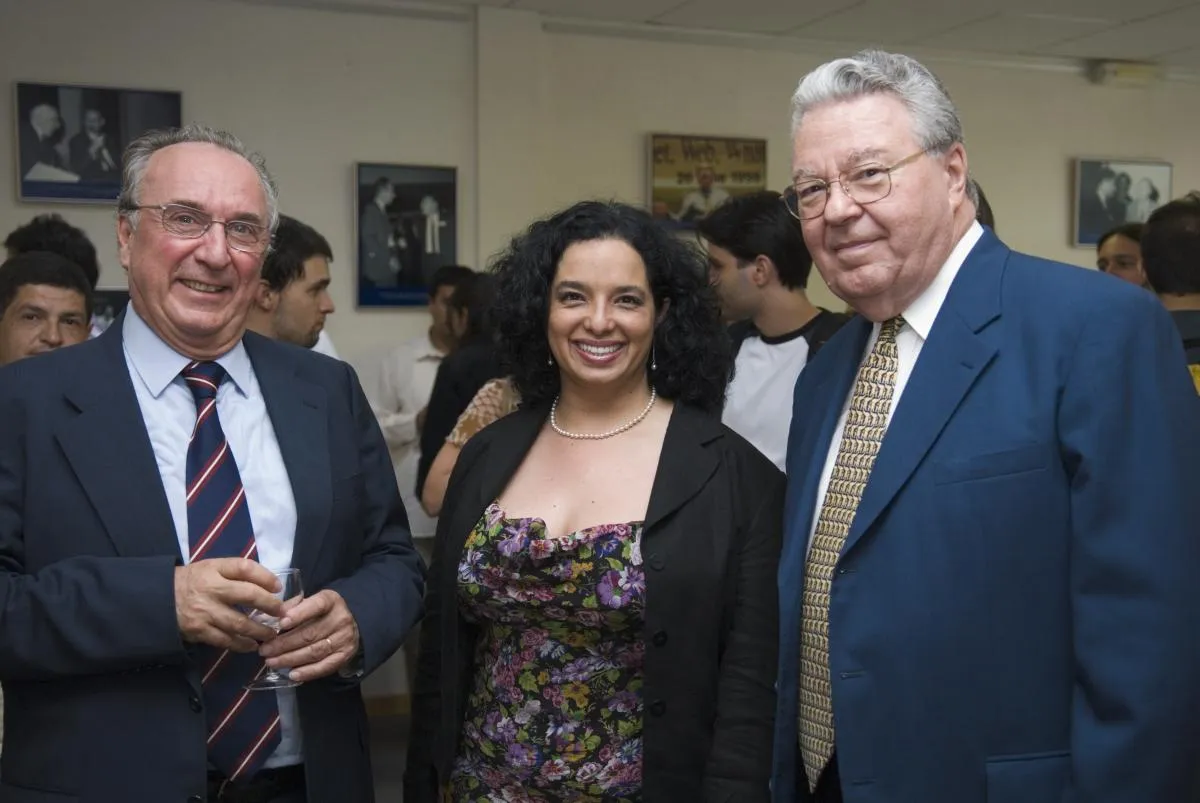
Spring 2006. From left: Luciano Maiani, Veronica Riquer and the Director General Robert Aymar celebrate the start of HELEN at CERN.
What happened when the HELEN project ended?
V.R. Naturally, we felt a bit sad when the program finished and we considered running HELEN-II. Unfortunately, this was not possible as the rules of the ALFA programme had changed. We spent some time looking for different EU programmes that could ensure the continuation of the project. The opportunity came with the 7th Framework Programme – Marie Curie People. The guidelines were different this time and only Latin American countries that had signed a special kind of agreement with the EU could participate. The approval of the Programme has been a nice surprise, since it was oriented towards the support of Europeans that travel to Latin America, whereas in the EPLANET project the majority of people travel from Latin America to Europe
L.M. Unfortunately there was a big interruption between the end of HELEN and the start of EPLANET, with the latter starting February 2011 and the former having finished April 2009. In the beginning, EPLANET encountered some difficulties mainly due to organizational reasons. Consequently, many groups could not work on the project, even though they wanted to. However, these problems have now been dealt with and we are making good progress. It should also be mentioned that HELEN resulted in agreements made for instance by Chile with ATLAS, by Argentina with ATLAS etc. In Brazil the Tier 2 of the LHC data GRID was made. In view of these achievements, EPLANET aims to consolidate collaborations, thus stabilizing the relationships of these countries with CERN. In addition, EPLANET has been very useful in boosting European participation in Auger. Hence, the collaboration worked both ways. Obviously, the groups from Latin America that come to CERN are more than those who go from Europe to Auger but it is nevertheless a significant enterprise.
What do you expect from EPLANET in the future?
L.M. I would like to see some of the countries that participate in the project establishing permanent relationships with CERN. This means stabilization of the financial support for HEP research in these countries, a problem that has always been the endemic disease of physics, particle physics in particular, in Latin America. Juan Antonio Rubio gave me a lengthy report on the situation in Latin America in 2000-2001 and the evidence that emerged demonstrated the difficulty of physics groups to get stable financial support. Clearly, HELEN and EPLANET have proved to the governments that with solid support many things can be done. I really hope that these countries will become permanent members of the CERN community. I don’t think I will participate in another project but maybe somebody else will take the lead. Finally, I hope that there will be another European project after EPLANET ends.
Summer Student at CERN: An amazing opportunity
How did you decide to apply for the summer student programme?
Hans Danielsson who works at CERN had a presentation during my third year at my university and meantioned this program. I had already thought about applying as a technical student for my master thesis. So when I heard about this I figured it could be a good way of learning more about CERN and what types of positions they have.
What is your previous background?
I have never been to CERN and wasn’t very familiar with the physics programme of the LHC actually. Of course I knew of what types of physics it was designed to look for but not the details of what the different experiments did or why a they had chosen a hadron collider for example.
Tell us a few words about your project.
I work at LHCb and I am analyzing data for an estimation of the effective cross section of LHCb. I chose to do offline data analysis with Monte Carlo because I figured that would be closest to what I might want to work with in the future.
The cross section is important to the experiment since we want to know at what rate certain processes are produced in the detector.
Is your experience so far close to what you were expecting?
I am too overwhelmed by the experienced that I don’t know what has impressed me the most. The opportunity, the people who work at CERN, the lecturers, my fellow summer students, the lectures, Switzerland, France, the detectors. I guess I am most impressed by everything I have learnt just by being here.
From my time as a summer student at CERN I will certainly remember…
How amazing this opportunity is. I mean, if you think about it. We learnt almost everything about CERN, even things that I could never imagine and the rest of the day we worked on a project together with our supervisor which for me was a new and very interesting experience. Since I am making a poster about my project to take home and put up on my wall I will remember the project as well. I will also remember the fun I had with the summer students (including also PhD students, technical students and others…).
CERN Summer Students: A summer to remember!
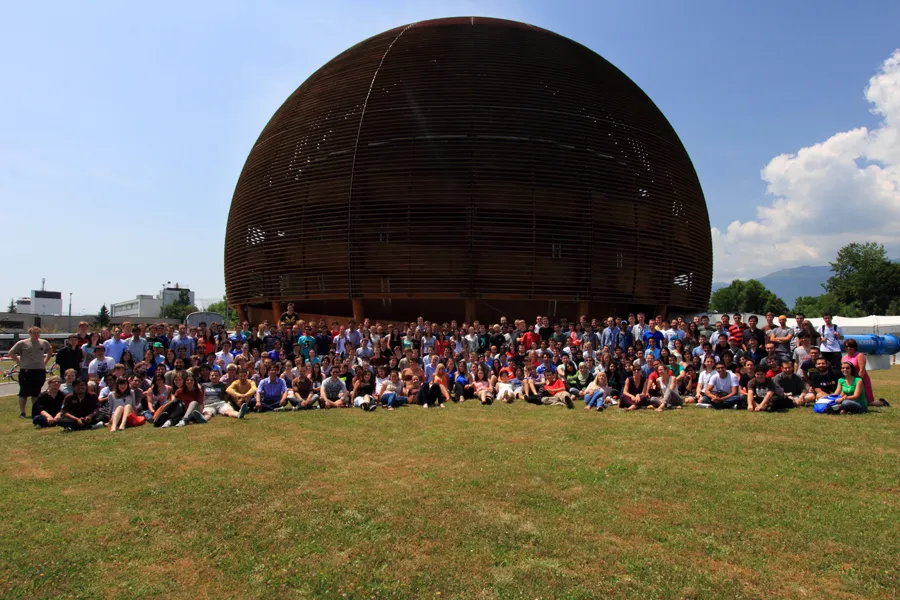
Summer Students had the unique opportunity to get a glimpse of the life at CERN by attending fascinating lectures, visiting the underground facilities and working in the experimental teams. In addition, besides developing their academic skills, the summer school experience will help the participants establish useful contacts with students and scientists from all over the world.
The organizers had prepared a rich and diverse programme of activities in order to offer the students an unforgettable experience. It included lectures as well as hands on practice; therefore providing extensive scientific expertise. In addition, the participants attend workshops on silicon sensors, data acquisition, scintillating crystals, cosmic particles etc. and work in the ALICE experiment. Moreover, a poster session took place, where students were able to present their work in the form of a poster. Students also shown great enthusiasm for the CERN Summer Student Webfest and worked in teams to design and develop apps that encourage the public to learn more about CERN, the LHC and particle physics. The students also had the chance to deliver a ten-minute lecture on their work project in the Auditorium, which was filmed and made available online. Finally, every participant is expected to produce a report, describing their experience of their project work at CERN.
Member State Summer Students 2013: A word from the organizers.
The Summer Student Programme does not mean only work during the Summer for the HR team – the Programme for us begins in October with the publication on the web of the vacancy notice for the programme and ends when the last students leave at the end of the following September. Applications are considered and validated from October to the application deadline, usually at the end of January. Assessing over 1500 applications is quite a task! And that’s just Member States – we have the same number of Non-Member States applications too.
The selections are made in March by the supervisors and the lucky students are informed in April. Contracts are prepared and sent in May and the first students start arriving in June. On each of the 5 arrival dates the Summer Student team meets and greets the students for a brief induction session to inform them about their Summer at CERN. Whilst the students are here we organize visits to the experiments, small hands on workshops around CERN and coordinate the 6 week lecture programme. We organize a welcome drink and Poster session and student sessions (where the students give their own lectures about their assigned project). All in all we are here to help the students have a fruitful summer and get the most out of their time at CERN.
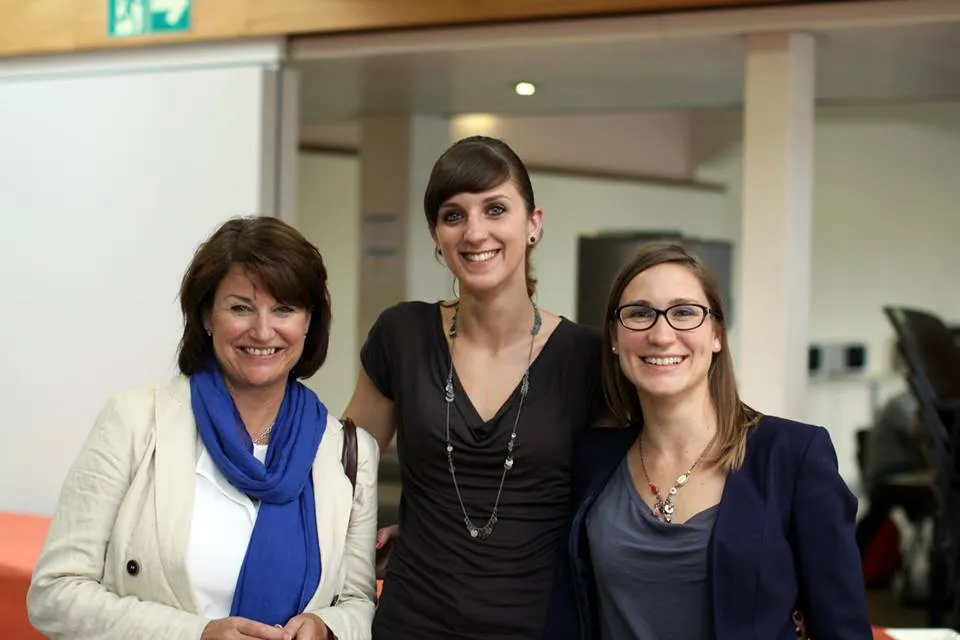
From left to right: Sharon Lynne Hobson, Eva Tolosa, Laura Salnier: the HR team that ensures that CERN Summer Students get the “Best summer of their lives”.
So for the HR team, the Summer Student Programme keeps us busy throughout the year and especially whilst the students are here from June to September, but it’s all worth it as at the end of their stay many students say it’s been “the best Summer of my life”.
Non-Member States (NMS) Summer Students Programme: CERN opens to the world’s young
The NMS Summer Student Programme gives an alternative summer option to undergraduate students of physics, engineering, computing and mathematics, who are nationals of Non Member States of CERN. The Programme offers a first-class education course while the students have the unique opportunity to make valuable contacts within the scientific community, as they constantly collaborate and socialize with many different people in a multicultural, multidisciplinary environment.
The NMS Summer Students Programme constitutes an important part of CERN's policy of promoting greater global integration in particle physics. According to Emmanuel Tsesmelis, the coordinator of the Programme, many former NMS summer students have gone on to bright careers in science and they have often facilitated scientific collaborations between CERN and their countries.
Although being a summer student is definitely a remarkable experience, there are special challenges for NMS nationals. Many of them have never left their countries before and Europe offers a new cultural experience to them. They have to adjust to new lifestyles, languages and not to mention more day-to-day habits. Another problem for the students from the southern hemisphere is that their university classes are in session during the European summer. For this reason it has been suggested that CERN should consider setting up a winter school at CERN during the European winter that will offer the opportunity to students coming from the southern hemisphere attend outside their university semesters.
There are also several administrative issues to be dealt with, such as the visa required for most of the NMS students, correspondence with applicants and professors, arrangements for financial payments, organization of the student application files etc. Thanks to the invaluable help and support of Marina Savino (PH-UCM), Michelle Connor (PH-AGS), and Anca Burghart, these admistrative issues are settled successfully. One of course should also acknowledge the important role of Morna Robillard (PH-EDU) who recently retired.
As Emmanuel Tsesmelis notes, the Programme, which started out under John Elllis, has developed significantly over the past ten years. In 2003 there were 30 NMS summer students and in 2013 there are already more than 130.The selection process is very competitive and only the very best students can be chosen. In 2013, only 8% from 1600 applicants has been recruited. Although for now it seems impossible to accept more students it is certainly something we are considering for the future.
The NMS Summer Students Programme is financed only partly by CERN, which allocates funds mainly to students from developing countries. Additional funding is provided by the governments and universities of the Non Member States. There are also several organizations that support NMS summer students. For example, the Paul G. Allen Family Foundation has disbursed grants to many students from Sub-Saharan Africa, the Engin Arik Memorial Fund supports Turkish students and Procter & Gamble has supported students from developing countries. Tsesmelis states: “we are very grateful to all the external sponsors of the NMS Summer Student Programme] and we want to continue our collaboration in the future”. Altogether, sources of external financing are vital to the continuation of the Programme.
CERN Schools of High-Energy Physics
Each year CERN organizes Schools that give junior researchers the chance to learn about recent developments in High-Energy Physics (HEP). Two Schools are organised by CERN every year: namely the annual European School and another School that is organized alternately in Latin-American countries (in odd-numbered years) or in the Asia–Pacific region (in even-numbered years). Each series of Schools is organised in collaboration with other organisations – e.g. JINR for the European School – even if a very large part of the practical organization is often done by CERN. Needless to say, for each individual School, partners in the host country also play an important role.
The CERN Schools of HEP date back to the early 1960s. The first schools were organized in Switzerland, near CERN, but soon they were held annually in other countries. Starting in 1970 some of the Schools were organized jointly with JINR, CERN’s sister organization in the former Soviet Union. Since 1993 all of the European Schools have been organized in collaboration with JINR; a collaboration that exemplifies how a common interest in science can bring people from different nations together in order to work in harmony with the common goal of expanding human knowledge. This has always been the aim of the School; bringing together young physicists from many different countries and putting them to work together during two intense weeks. The organizers make an effort to mix participants from different regions and promote cultural exchange, and considerable emphasis is put on promoting informal interactions between the students and the staff at the School.
The idea of holding similar Schools outside of Europe dates back to the late 1990’s. Given the strong and increasing interest of the Latin-American countries in HEP, it was decided that a School should be organized to encourage further participation in experiments. The aim was to prepare young people for research in experimental HEP, helping physicists who had previously undergone theory training, as is often the case in Latin-American countries, to take a step towards experimental physics. During the last years, the Latin-American community has been growing and the Schools have played an important role in this together with the EU-funded HELEN and EPLANET programmes. Institutes in several Latin-American countries have subsequently joined LHC experiments.
The first Latin-American School was held in Brazil in 2001, with subsequent events in Mexico (2003), Argentina (2005), Chile (2007), Colombia (2009), again in Brazil (2011), and most recently in Peru (2013). Whereas, typically, there were about 50 student participants in the early schools, compared to about 100 in the European Schools, the numbers continue to increase with many highly-qualified Latin-American applicants, from which a selection is made within the constraints of the available funding.
The Latin-American schools have served as a model for the new series of schools in the Asia-Pacific region that started in 2012. CERN and KEK worked together on the practical organization of the first school, held in Fukuoka, Japan.
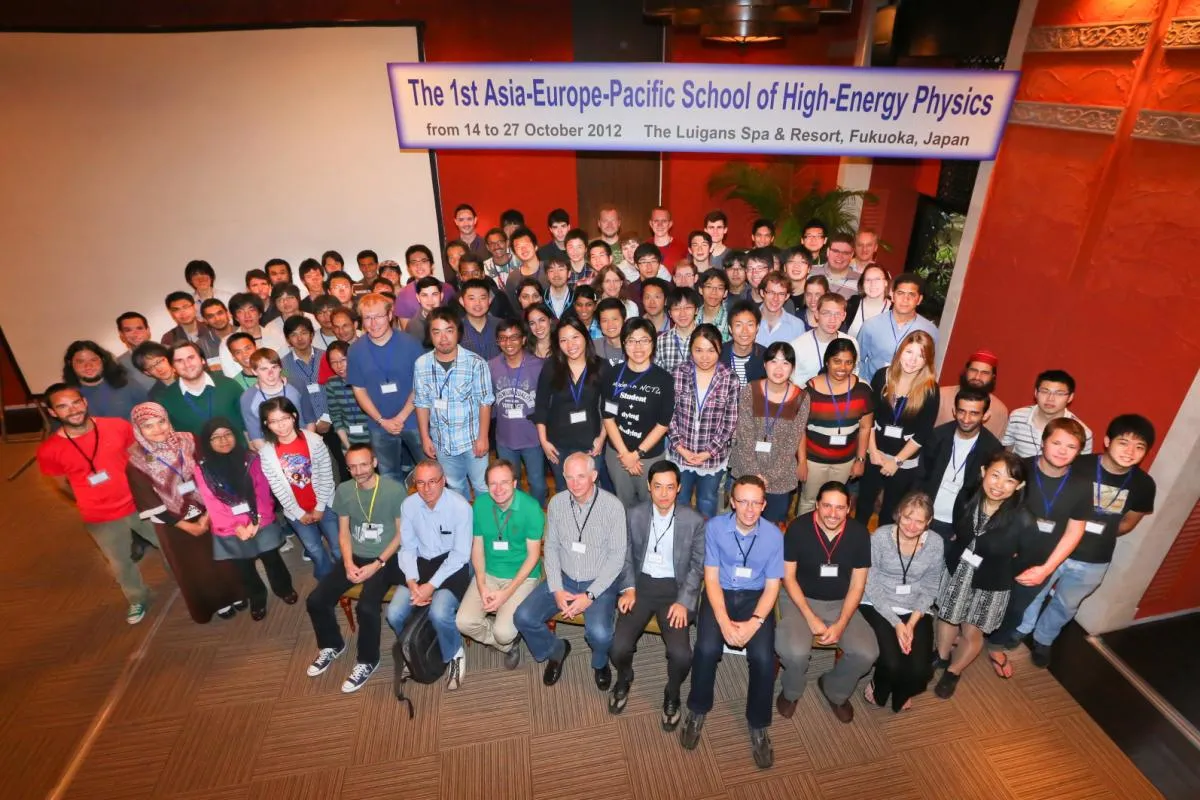
The participants of the first Asia-Europe-Pacific School in 2012 in Fukuoka, Japan
The Schools in 2013
This year, the Latin-American School was held in Arequipa, Peru, and the European School in Parádfürdő, Hungary. In both cases the number of applicants for the school far superseded the number of participants, with more than 130 applications in the case of Peru, for 65 available places, and over 200 for the European School, where 110 students were selected. Nick Ellis, director of the CERN Schools of Physics explains: “most of the applications were submitted by highly qualified candidates and making the selection proved to be a tough job”. An important criterion for the organizers is the applicant’s potential to pursue a career in physics research while the level of experience is also taken into account. It is often the case that candidates might benefit by waiting another one or two years until they are in a better position to profit fully from the lectures and interactions with fellow researchers in training.
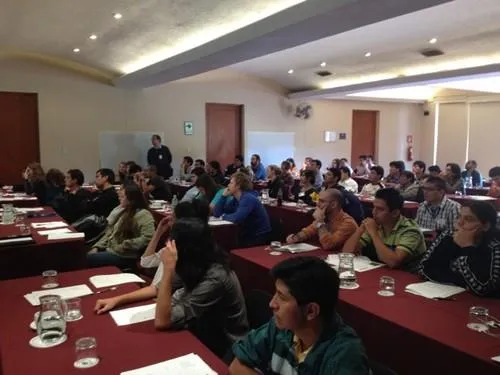
Students attending a lecture at the 2013 Latin-American School.
The Scientific Programme
The scientific curriculum of the Schools includes an intense programme of lectures given by leading scientists in the field. The main focus is to teach theoretical physics relevant to experimental students, but in recent years a course on statistical techniques has been added, which proves to be a very popular topic among the students. In the non-European schools, instrumentation is also included in the curriculum. Lectures are complemented by discussion sessions where students work in small groups of about 15 people under the guidance of a discussion leader. In the discussion sessions students have the opportunity to bring up any questions related to the lecture material, and discuss them in an informal setting with fellow students, the discussion leader and the lecturers who visit the various groups.
In recent schools, the students in each discussion group have also been asked to select a published experimental paper and collaborate in order to understand the analysis and the interpretation of the results. Then, on one of the last evenings they are asked to present their paper to the other groups. “When we set this project work, some of the students are uncomfortable that we have not given sufficient guidance on what they are supposed to do. However, that is exactly the point, to teach them to work more independently and develop their own ideas in collaboration with their colleagues.” says Ellis. The programme of the School also includes a student poster session where many of the students present their own research work to other participants including teachers and the organizers. Thus, students have the opportunity to discuss their own work with some of the leading experts in the field and develop their skills in teamwork in a context very relevant to their future work as researchers.
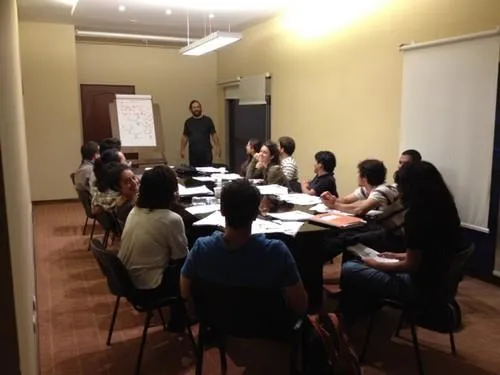
A photo from one of the student discussion sessions in Arequipa
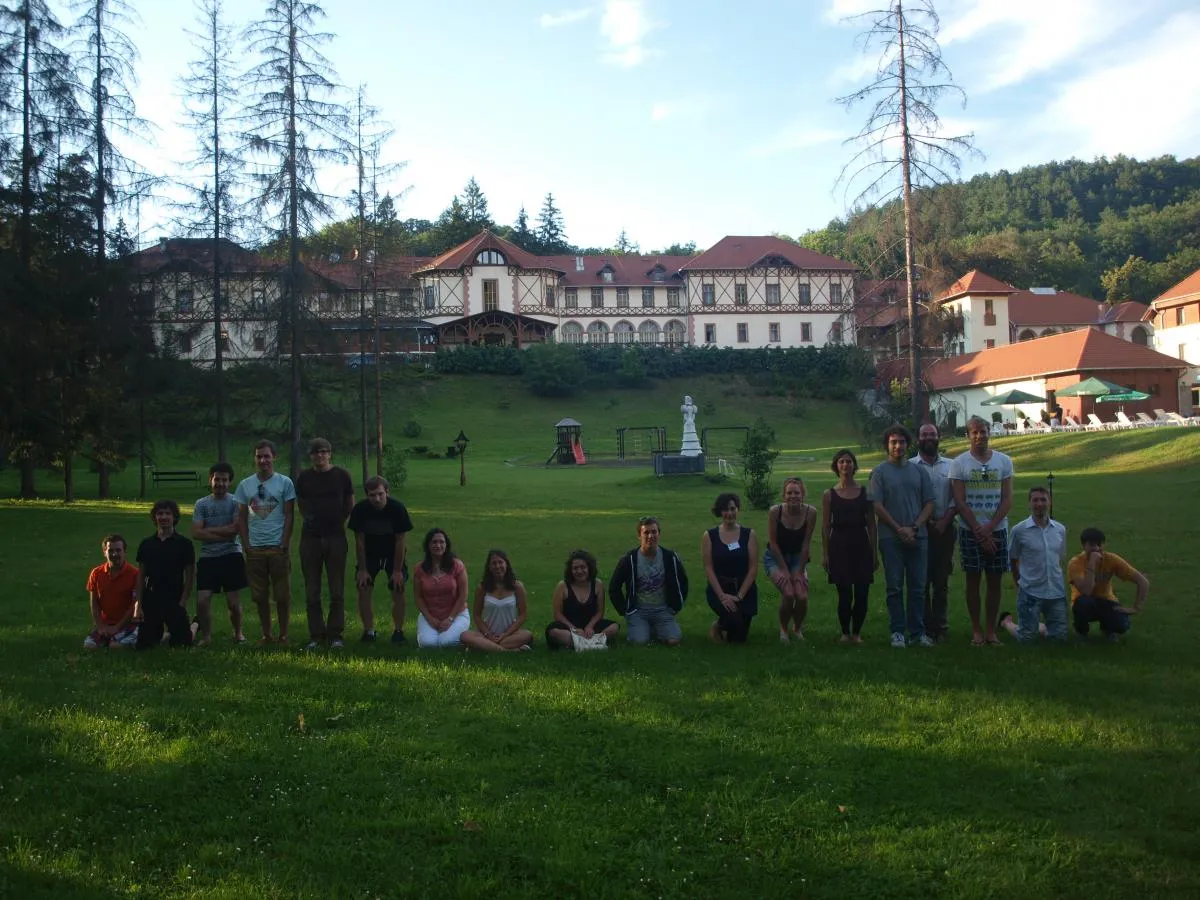
A discussion group at the European CERN School in 2013, simulating a double ridge structure observed in p-Pb collisions, with the School’s hotel in the background. The picture was later used in their winning project presentation.
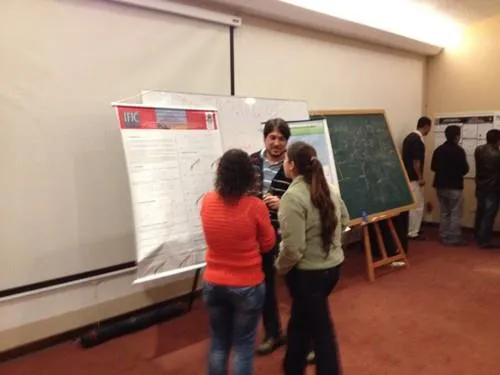
Students discussing their own research during the poster session at the 2013 Latin-American CERN School in Peru
Outreach
"Often the School offers opportunities for outreach activities” adds Martijn Mulders, the Deputy Director of the CERN Schools of Physics. “Both in Peru and in Hungary newspaper journalists and local television crews visited the hotel for interviews with some of the students and staff at the school." he continues. During past schools students have also visited local schools to talk about their work, and in some cases a public CERN event happens at the same time as the School. For example, the European School in Hungary coincided with the opening of the new computing Centre at the Wigner institute in Budapest. This allowed the Directors General from CERN, Rolf Heuer, and from JINR, Victor Matveev, to visit both the opening ceremony in Budapest and give a lecture at the School in Parádfürdő. Every year since the start of his mandate Heuer has visited the European School and talked about the CERN scientific programme, which is always highly appreciated by the students. At these occasions he also talked informally with the students, and important contact with the next generation of researchers.
Organizers
Organizing a School means a lot of work for many people. Preparations usually start more than a year ahead of the event and involve a lot of administrative and practical work in addition to preparing the scientific programme. Many people in the CERN Physics Department contribute part-time to the Schools’ organization, including Hélène Haller and Kate Ross on the administration, as well as physicists who participate as lecturers, discussion leaders and members of the organizing committee. The work is done in partnership with a team of organizers from the host country of each school, and where relevant with colleagues from other international organizations.
The next schools will be held in the Netherlands, India and Ecuador and details may be found on the School's website:
http://physicschool.web.cern.ch/physicschool/default.html
SFT participates in 2013 Google Summer of Code

In 2013, CERN/SFT is participating in the Google Summer of Code (GSoC) for the third time, following previous years' great experiences.
The group submitted proposals for a variety of projects, covering a wide range of their activities. More specifically, student developers had the opportunity to sharpen their programming skills by developing ideas and contributing code for the ROOT package, Geant4 and CERN Virtual Machine amongst others.
John Apostolakis and Jakob Blomer (PH/SFT), are the organizers of the SFT group in GSoC, and act as administrators for the CERN-SFT participation and liaisons to the Google organizers of GSoC. They collected the ideas for potential projects from different group members, who were willing to mentor the students. Each project concerned developing a feature for open source software that the group is working on.
CERN-SFT was awarded eight students slots for the second year in a row. Six of the projects concern software developed in SFT. These spanned improvements to the Cling interpreter and an improved formula class in Root, refinement of configuration mechanism for the CERN Virtual Machine, and a focused performance monitoring for a region of code. Two projects are related to different groups, a union filesystem in LHCb and the extension of mathematical editing for the Indico project in IT. The list of the projects and their description can be found at: http://www.google-melange.com/gsoc/projects/list/google/gsoc2013
The students applied to GSoC, preparing a proposal of the work and discussing with their potential mentors. The students were selected in May, and started to work in mid-June. Mentors and students communicate constantly via email, instant messaging and Skype. Regular discussions enable mentors to follow and assist students with any questions or difficulties.
The mid-term evaluation of the projects took place in early August. The students will continue to contribute and communicate with their supervisors through to the completion date of the projects onSeptember 16, the 'pencils down' day.
After this date, students will have a week to scrub code, write further tests and improve the documentation. On September 27 the supervisors in collaboration with the students will begin to submit the final results of their work and on October 1 Google the final project-outcomes will be presented.
Interview with John Ellis
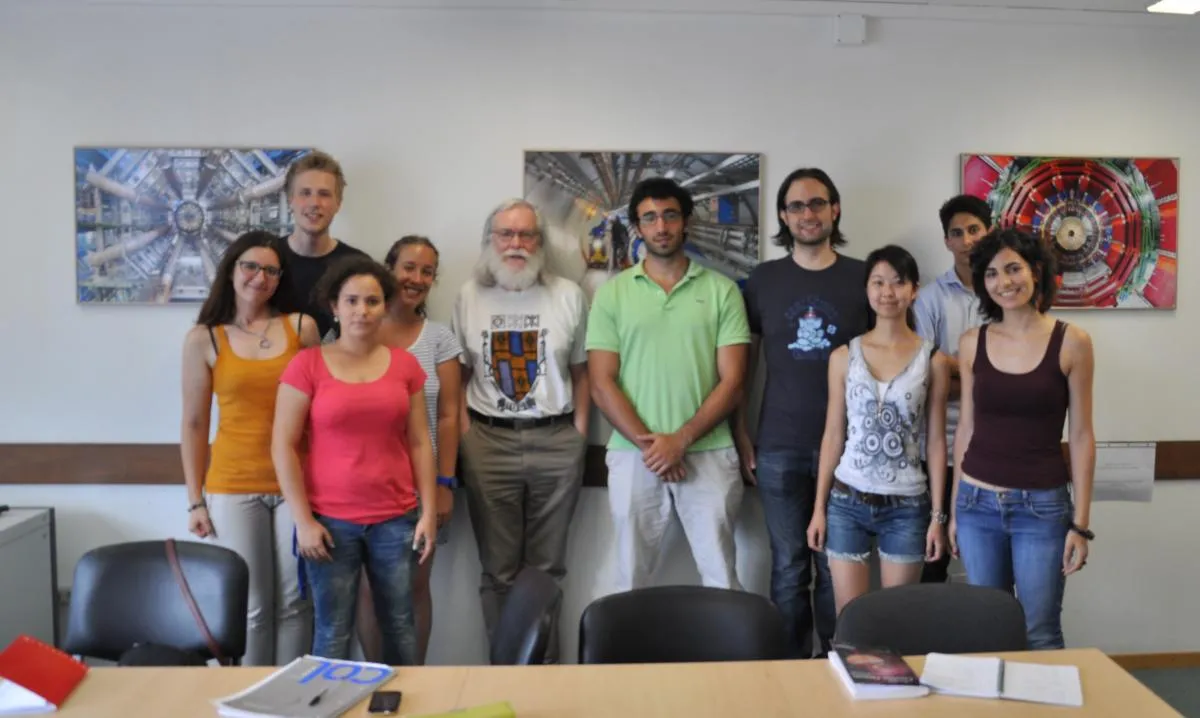
Summer students met and discussed with John Ellis about his early career in physics, his current research interests and his views on the relation between philosophy and science…
When did you decide that you would become a theoretical physicist?
When I was a child, my mother often used to take my sister and me to the local library. The adult section was from 14 onwards and when I was about 12 I couldn’t borrow any adult books, but the kid’s fiction was not interesting, so I started reading nonfiction and I read a lot of science and history books.
I was always interested in the most fundamental things, and for me physics was the most fundamental science For a long time I was torn between particle physics, astrophysics and cosmology, though my formal training was in particle physics. Finally, the field in which I am working now is a combination of the two.
Do you think that the influence from your family played a key role in becoming a physicist?
My mother who used to take me to the public library should take a lot of credit for that. On the other hand, neither of my parents was working on anything even remotely resembling science: my father was in the insurance industry and my mother worked at home. I was vaguely aware of the fact that my father had been good at mathematics when he was at school and that was about it. There was nobody in their circle who was a scientist. However, the headmaster in my primary school had been an Antarctic explorer, so maybe just the fact that I knew that made me think that there was something beyond everyday life, and probably that was another important influence.
Why are you doing science? Do you think that personal curiosity is the only factor that should drive scientific research?
I went into science because of my own curiosity. However, I am aware of the fact that science is supported by governments, and naturally they want it to be useful. Value can come out in various different ways.
One is training young people such as yourselves. I am prepared to bet that not all of you are going to finish your careers as research scientists, probably most of you are going to end up doing something different, but just the fact that you have exercised your science, technology, engineering and mathematics skills by being physicists or astrophysicists for a while, and by coming to CERN for a couple of weeks or months, is going to benefit you in your future lives.
I also firmly believe that the research we are doing at CERN does have societal benefit, as knowledge itself contributes to the advance/development of society. For example, I recently had lunch with a colleague who is interested in setting up a hadron therapy facility in Greece. This would be based on technology already developed by particle physicists. Moreover, there is a new design being prepared that uses current CERN expertise. In fact, CERN has helped several groups to build such facilities in their countries with technical advice, designs, training of people etc. This is just one example: I think there is a lot that an organization like CERN can do for the benefit of society.
Of course there is also the question of how the Higgs boson can be useful. We have no idea but every time in the past when fundamental physicists have selfishly followed their own interests and tried to understand nature better, and made some sort of fundamental advance, it eventually turned out to be useful. Take for example antimatter and medical diagnosis, Maxwell’s equations and mobile phones, the web and so on. Even the Higgs boson, though at first sight it seems to have no practical use, might turn out to be useful in the future.
Is your interest in the fundamental at a scientific or philosophical level?
I was always interested in fundamental science. But when I was an undergraduate student, I did do some reading on philosophy on the side – it was not part of my formal course. I struggled through Bertrand Russell, Karl Popper and other philosophers trying to understand the basic principles of epistemology and the philosophy of science. I don’t find philosophy helpful in my day-to-day research but I am always happy to debate with philosophers, and in fact I have been invited to philosophical festivals where I got the chance to discuss these issues around the table with philosophers. This is not to say that I don’t think physicists are philosophers. Even the absence of formal philosophy is in fact philosophy, but it is sort of a pragmatic minimalist philosophy if you like.
What is the interplay between theory and experiment?
I would not like to get into the chicken versus egg debate as to which is more fundamental: the theory or the experiment. If I had to choose I would have to say that obviously the experiment is more fundamental. On the other hand, a theoretical background is necessary in order to understand and interpret the experiments and predict the outcomes of other observations. If these predictions turn out to be correct then a model or theory emerges.
We scientists aim not just for a description of the data that we already have, we search for something that will give us some insight into the data that we don’t yet have. On the basis of empirical data a model is formulated and then that formulation can be used to make predictions for other experiments. It would be better if the results of those other experiments did not confirm the model exactly, because then we would get some hints how to improve our understanding of Nature. However, theory is just a human construction in order to understand the data: Nature is the boss.
I feel there is a symbiotic relationship between theory and experiment that is a little bit like going around and around the accelerator, with the theories giving you a little kick each time, enabling experiments to understand things a bit better at higher energies.
What is in your opinion the boundary between theoretical physics and pure speculation?
This goes back to one of the existential choices that I had to make when I started my PhD. One of the questions that my professor asked me was: “Do you want to do theory that has applications, or pure theory?” I said that I want to do theory with applications and, in particular, connections to interpretations of observations or predictions for observations.
Of course, some of the papers that I have written had absolutely nothing to do with experiments, but as time goes on, when I am working on some research project I consider more and more possible experimental astrophysical or cosmological applications of my work. I don’t like doing pure theoretical physics: that is just like mental gymnastics showing how clever one is.
BROKEN IMAGE NOT MOVED (drupal url : https://ep-news.web.cern.ch//node/3163)
As a theorist, do you think that if mathematics had followed a different path, historically, we could have developed a different formalism?
I think that there is only one mathematics, in the sense that mathematics is an expansion of logic; it is a construction of “interesting” logical systems. Of course “interesting” is a matter of taste. Some people would replace interesting by beauty. If you formulate it that way mathematics is really a vast subject and there is surely an incredible number of different pathways through it.
There were a couple of instances in the 20th century where physicists were bumping up against the boundaries of what was then known in mathematics. One example was Einstein when he was trying to formulate general relativity and it turned out that non-Euclidian geometry actually did exist. I am not sure how much he was aware of that before he discovered it himself. Another example comes from those working in quantum mechanics, who reinvented matrices for themselves to some extent. Dirac invented a whole new area of mathematics, distributions, because it was what he needed in order to carry out his description of fields.
In those instances, I don’t think that physicists were held out very long by lack of available mathematics. Either it was there, they stumbled across it and then they were able to use it or they started inventing it for themselves and immediately the mathematicians came in and formulated the theory in a more precise, general and useful way.
One area, though, where I think we lack the mathematical tools today is string theory. We grow up with geometrical ideas inherited from Euclidean idealized points and lines. But in string theory there are, as fundamental structures, extended objects. Originally people thought in terms of objects extended in one dimension, but then they realized in the 1990s that, for the consistency of the theory, they had to consider things extended in more than one dimension, and they started to talk about membranes and M-theory.
It is not clear whether any of these descriptions, in terms of objects extended in some fixed number of dimensions, is sufficiently general. Probably one needs some sort of generalized conception of geometry, which is a long way away from our original ideas of points. At the moment, I think that string theorists are handicapped by not having that deeper insight.
Do you think that understanding the origin of the universe might impact our way of thinking ?
I think that deeper fundamental understanding affects the way people think in many different respects. In the last century, the discovery of quantum mechanics really affected the way people think about nature. Special relativity certainly had philosophic implications, which I think people are still sorting through, and even read too much into it sometimes.
It was a shock for humankind to realize that we are living on an insignificant planet, going around an insignificant star in an insignificant galaxy and, as we have discovered, we are not even made of the same stuff as most of the matter in universe because most of it is some unseen form of dark Matter. Moreover, most of the universe is actually dark energy, and not any sort of matter at all. The universe has been going on for billions of years, not obviously caring whether we exist or not. I think that this observation is of a profound philosophical importance. Surely there will be more shocks if and when we understand better the origin of the universe.
What is the most effective way to communicate science to the general public? What level of detail and which is the language that should be used?
I don’t think that there is a single simple recipe for this; there are many different ways to engage with the general public and reach different types of people. It is our obligation as scientists, who are funded by the general public, to communicate with them what we are doing, describe our results, and respond to their questions and concerns. It is really imperative to our technology based society that we strive as much as we can to raise the general level of scientific literacy and develop a critical attitude towards assessing evidence. I do a lot of outreach and sometimes I talk to school kids, sometimes I talk to high school students, sometimes to more general audiences. Two weeks ago I did something which I haven’t done before; I participated in a gig at a night club. It was in Manchester in a vault under a railway station. It started off by me being interviewed by a punk rock musician and there was also a presentation about astronomy and extraterrestrial life. The evening finished with a set of punk rock music by a group called the Membranes, played with a backdrop of slides summarizing M-theory. Maybe that reached a new audience? Musically, punk is the ultimate music of defiance, and philosophically I believe that defiance the only possible attitude towards the apparent indifference of the universe.
How do you feel about science teaching in schools? What could change in science education at schools?
I think that a good laboratory for doing experiments is needed in every school, and I was relatively fortunate because I went to a school that allowed us to conduct real experiments. However, I think that one of the problems in high-school science teaching is that usually you know the results of the experiments in advance, and you just verify that the data fit the model. It is probably quite difficult to design activities for high school that give students more open-ended activities than just repeating the same old experiments time after time. Unfortunately, I am aware that many schools don’t have specialized physics teachers. Maybe there are teachers that have some background in science but they are not necessarily physics teachers.
I believe that CERN can do many things to support high-school teachers and therefore high school learners. Some 15 or so years ago we set up a programme for high-school teachers here. We started off the first year with a dozen participants and now almost a thousand high school teachers visit CERN each year spending a significant amount of time. The programme aims to expose them to current developments in physics, to bring them into contact with each other so that they can exchange ideas in teaching physics and to recharge their enthusiasm.
Which do you think, at this point of your career, is more important outreach, or science?
I try to find a balance between the two. I think that it is natural for young scientists to be more focused on actually doing science, and I believe that older scientists have to provide them with some sort of framework that makes that possible. When I was head of the Theory Division at CERN I used to think that my job was to make the external world invisible to theorists working here. They shouldn’t have to worry about money or working conditions; they should just get on with the physics. Outreach is part of what we must do to make that possible. That said, I think that young scientists have also something to contribute in terms of outreach, because they are closer in age to young people, who are perhaps more susceptible to having their career choices affected. I also think that young scientists are more likely to be responsive to the people out there. This can benefit the young scientists themselves giving them new ways to look at their work. I am unlikely to change what sort of science I do after giving a public lecture, but maybe younger scientists would. However, I wouldn’t tell them that they have to spend x% of their time in outreach.
Have you ever had a “Eureka moment” in your years of theoretical work?
I can recall two such moments.The first was in 1975. At the time we believed that the quarks were held together inside protons and neutrons by gluons. There were many good theoretical reasons for thinking that quarks were real, and also that these gluons were real, but nobody had found direct experimental evidence for the gluon.
I had just had a coffee downstairs in the cafeteria and was walking back to my office when, as I was rounding the corner by the library, I had an idea for how you could demonstrate directly experimentally the existence of gluons. That was a “Eureka moment” when I felt I was the only one with this insight. Then I got together with a couple of my colleagues, we wrote a paper, we told the experimentalists about it, and some 3 years later they found the gluon in the way that we described.
At that time, we had a whole bunch of data about what happens when you scatter electrons off protons and there were different theories for what might be going on. This gluon theory fit the data but there were other things that fit the data equally well. However, with this theory there was a more fundamental understanding of what was going on and that enabled us to make predictions.
That happened here at CERN, and I was wearing clothes, so it wasn’t the traditional “Eureka moment” of Archimedes. But some years later I did have an idea while I was lying in the bath, and I did jump out and run around the house shouting “Eureka”, just to do it properly.
BROKEN IMAGE NOT MOVED (drupal url : https://ep-news.web.cern.ch//node/3163)
Do you think that string theory could be a theory of everything?
Once I was asked to write a review article for Nature, which had the title String theory: a theory of everything or of nothing?. This is still an open question; although I would now say that it is at least a theory of something, because it is useful for understanding heavy-ion collisions and some aspects of condensed-matter physics. I still think that string theory is the best and possibly the only candidate that we have for a theory of everything. But we are a long way away from finding any experimental proof of that.
What do we mean by referring to a theory of everything?
That is another debate. We have a Standard Model that describes data very well, and we have a theory of how quarks gather inside protons and neutrons that we can use to calculate on the lattice the properties of strongly-interacting particles. But that is not always the case when you go to the next layer of the cosmic onion. For example, we have an understanding of protons and neutrons but we still can’t say that we can describe the nuclei in great detail. And we understand how electrons bind with nuclei to form atoms but we don’t always understand in a precise way how the properties of materials emerge. Of course we can always make simplifications and models, but we are not in the position to calculate their properties from first principles.
When I talk about a theory of everything, what I have in mind is that we discover what the first principals are, and run experimental checks to be reasonably sure that this is actually the right answer, not that we calculate every physical phenomenon in detail. In the past, by discovering the gluons, we could have a reasonably good conviction that the quarks and gluons were the underlying theory of protons and neutrons. But this did not necessarily mean that we could (or ought) to calculate everything in nuclear physics.
From that point of view, “theory of everything’ is perhaps rather too heuristic a term, and we should never abuse it. It might be that we will be lucky and eventually come up with some formulation, but there would still be things that we couldn’t calculate. Maybe we come up with a theory that we are convinced is right but we cannot actually calculate things at the next level up in the onion. As I mentioned, there are historical precedents for that.
Which is the most important thing that you expect to find out from the upgrades of the LHC? Which property of the Higgs boson do you expect to be more crucial for understanding Nature?
If Nature is kind, the upgrades of the LHC may reveal a whole set of new particles, as in supersymmetric theories. As for the Higgs, I cannot give a specific answer to that as there are so many different measurements to be made at the LHC. For example, how Higgs decays into different particles, different ways to produce the Higgs particle, how the cross section changes with energy, angular distributions and so on. The Standard Model makes a very specific set of predictions, and other theories may disagree with the energy dependence, or they may suggest that its decay into muons is going to be different, etc.. I think that you should keep on searching through all these things … production mechanisms, decay mechanisms are not predicted in the standard model. Of course you can never prove that it is the Standard Model Higgs boson, but you may be lucky enough to prove that it is not. I sincerely hope that the outcome of these experiments will be the discovery that it is not the Standard Model Higgs boson, and that there has to be some new physics. If a discrepancy is discovered with the Standard Model, then the new physics would have to be at accessible energies.
John Ellis: I would like to finish with a question to the students which you don’t have to answer but you just go away and think about it. The question is whether you are doing what you really want to do. Physics takes dedication, but rewards it.
John Ellis was interviewed by Silvia Manconi, Maria Brigida Brunetti, Cristina Martin Perez, Rodrigo Gaston Cortinas, Catherine Hsu and Gudmundur Stefansson.
We would like to thank Cian o 'Luanaigh (DG-CO) for his useful comments.
TH Institute: Amplitudes, String Branes
A TH institute on the theory of scattering amplitudes and string branes was held from 15 to 26 July, offering a space where experts in the field exchanged and furhter developed their ideas.
The theory of scattering amplitudes has seen rapid progress over recent years, with development on many fronts, often driven by the huge success in applying on-shell methods. New symmetries and integrable structures in the the scattering amplitudes of planar N=4 super Yang-Mills theory have led to new formulations of the problem of calculating scattering amplitudes. The duality to light-like Wilson loops has led to the application of OPE techniques to constrain loop corrections to scattering amplitudes, with a striking similarity to the application of Regge theory on the amplitude side. At strong coupling, techniques from integrable systems have been applied to the corresponding minimal surface problem. In perturbation theory, recursive techniques allow the construction of the integrand to all loop orders while the algebraic and analytic structure of multi-variable polylogarithmic functions has been a crucial tool in studying the integrated amplitudes. In many settings the natural language for the above developments is twistor theory. Trying to unify the above ideas to understand scattering amplitudes at finite coupling will be one of the main challenges in the near future. There has been much related progress in understanding amplitudes beyond 4d gauge theories. Progress in the theory of M2-branes has led to new 3-dimensional superconformal field theories which can be studied using similar techniques to those in four dimensions, revealing similar integrable structures. Applications of on-shell methods have led to new ideas regarding the ultra-violet properties of gravitational theories with much focus on the maximal N=8 supergravity theory. Recently, new and surprisingly simple formulations of tree-level gravitational amplitudes have been found indicating that there is still much to be understood about the structure of amplitudes in such theories.
In turn there have been recent advances in understanding the structure of string theory scattering amplitudes. KLT-type relations between open and closed string amplitudes have suggested a powerful duality between color and kinematics in gauge and gravity amplitudes. Pure spinor methods have been used to derive general N-point disk amplitudes. Meanwhile, progress has been made in defining superstring perturbation theory at multi-loop level. Ideas from twistor string theory have also led to interesting new techniques in field theory.
The TH-Institute was organized by: J. Drummond, H. Johansson, N. Lambert, M. Spradlin, A. Volovich
Antimatter Event with Rolf Landua: Everything you wanted to ask.
Shortly after Dirac’s prediction, the first antiparticle was discovered in 1932. Since then, antimatter has been largely studied and produced in many experiments in order to help unrevealing the mysteries of the Universe. Antimatter has also reached the general public through science fiction, especially through Dan Brown’s bestseller Angels & Demons in 2000 and the following movie by Ron Howard in 2009. LeClub Association held an event on 21st of July at CERN aimed to clarify the truth and false of antimatter and its production.
As one of the premier physics research facilities in the world, CERN has always been the subject of interest and questioning from the general public. Dan Brown’s 2000 thriller novel Angels and Demons, and the subsequent Ron Howard film, are key examples of such media infatuation. Following the release of the film in 2009, the antimatter experiments in particular stepped onto the public stage, bringing with them Antimatter Decelerator (AD) co-founder and CERN researcher Dr. Rolf Landua. But amidst all the media coverage, many questions arise: is antimatter dangerous? Or rather, can it be a source of renewable energy? And what is the true science behind all the fiction?
On July 21st, CERN held a public screening of Ron Howard’s Angels and Demons in the Main Auditorium, drawing a crowd that included CERN employees and tourists alike. In the film, scientists at CERN use the Large Hadron Collider to create one gram of a highly volatile substance called antimatter, which annihilates with matter to produce a catastrophic explosion. Landua played a key role in the initial stages of the movie, when he worked closely with Howard as a scientific advisor. Following the screening, he gave a brief talk about the film, explaining to an attentive audience what antimatter is, how it is made, and several mysteries that are to be resolved in the experiments at CERN.
BROKEN IMAGE NOT MOVED (drupal url : https://ep-news.web.cern.ch//node/3163)
Terrence Baine (left) and Rolf Landua (right) with an antimatter trap from the film ‘Angels & Demons’. (Image: CERN)
As both an antimatter expert and a science fiction lover, Landua easily clarifies the physics concepts behind the movie. Casting light on the complex questions addressed in the film is quite difficult, yet Landua does it perfectly. He succinctly addressed the key question brought up by the film: is antimatter an energy source that can be used as a weapon? The answer (with a sigh of relief from the audience)— no. Antimatter, in accordance with energy conservation laws, is an energy storage, but is not an energy source. Furthermore, the efficiency of antiproton production is such that it takes about 1,000,000,000 more energy to make antimatter than will finally be released by annihilation. Nevertheless, Landua sees no harm in taking some scientific liberties in the movie’s script, explaining that “science fiction is entertainment, but it can generate interest for science.”
Indeed, Dr. Rolf Landua finds that even scientists can be inspired by cinema and literature in some way. “Science fiction has the advantage that you can think freely,” he explains, it’s a way for scientists to think outside the box. But despite extoling its virtues, Landua warns that science fiction should never be seen as a teaching tool. The scientist, who is highly committed to science education, focused his main goal for the next years in trying to “introduce a completely different way of teaching physics, starting from the 21st century, and not from the 16th.” While he asserts that he became a physicist “in spite of” his teacher, Landua sees the importance of teaching science in a practical and attractive way, so “when kids come out of school they know at least that the universe is comprehensible”. He declares that the ‘textbook’ way of teaching today has little success, as it has no connection to the real world. “I have only used [kinematics] once in my life, when my cat fell from my balcony,” he jokes.
Landua completed his Ph.D. thesis on exotic atoms at the University of Mainz in Germany before coming to CERN in 1980. Since his arrival at CERN, Landua has worked in several experiments studying antiprotonic atoms, meson spectroscopy and exotic bound states of quarks and gluons. He served for five years as spokesperson for the ATHENA experiment, which produced millions of slow moving antihydrogen atoms for the first time. When asked about the most important issue in antimatter physics today, his answer is simple: to find out if there is any asymmetry between matter and antimatter that could be the reason for the dominance of matter in the universe. Differences could manifest as minor alterations with extreme consequences for modern physics; for example, even the slightest difference in the gravitational constant between matter and antimatter would constitute a huge scientific discovery. It is these issues that Landua hopes will be answered at CERN in the coming decades.
BROKEN IMAGE NOT MOVED (drupal url : https://ep-news.web.cern.ch//node/3163)
Rolf Landua stands at the entrance to the Antiproton Decelerator (AD) control room (Image: CERN).
In accordance with his efforts to promote the public understanding of physics, Landua currently leads the Education and Public Outreach Group at CERN. Amongst exhibition projects aiming to improve guided tours at CERN, he is also advising the development of a childrens’ TV series about fundamental physics, in collaboration with the European Broadcasting Union. In this sense, innovation at CERN spans the fields of education and science alike, and Dr. Rolf Landua is at the forefront of both.
CERN Open Days are fast approaching
CERN OpenDays 2013 will be taking place in one month’s time. During Saturday 28 and Sunday 29 September 100 000 visitors are expected in the world’s biggest laboratory.
The organizers have prepared a rich programme that aims to entertain and educate the visitors. It includes visits to the laboratories, performances, and other activities.
Earlier this month the first tickets were released through the online reservation system and currently more than 35% of the tickets has gone. Visitors with reserved tickets will have the chance to visit underground points, including the LHC experiments, beam acceleration, and the beam dump system. It should be noted that tickets are free.
During the two days, a number of lectures will be given throughout CERN covering a wide range of topics. CERN scientists and experts will explore different topics ranging from the fundamental building blocks of matter and the Origin of our Universe to the relation between modern physics and the Arts.
The full list of lectures will soon be announced on the OpenDays website. It includes a number of Keynote presentations that will take place in the main auditorium on both from 9:30 to 17:30 . At the same time, there will be a number of special topics at the Globe and the Council Chamber, which will be simultaneously transmitted in both places, giving the visitors the opportunity to attend as many as possible without missing a word.
To run the Open Days we need the contribution of many. Volunteers are the key to this event and as guides, activity animators, lecturers, info agents, etc, volunteers will be present in all areas. “We are grateful to the 1500 volunteers who have already signed up. The assignment process is on-going and they will soon be informed” says Virginie Blondeau who is running the volunteers workpackage.
Maybe it’s time for you to get involved as more volunteers are needed; especially for underground visits and “traffic security”. As thousands of visitors will arrive at CERN during these days, a lot of parkings will be at visitors’ disposal and volunteers are needed there to welcome visitors and give information. As the organizers understand the difficulties of the “traffic security”role they have decided to assign four hour shifts.“ Volunteers will receive training, the satisfaction of being able to say “I was there!”, exclusive Open Days 2013-branded clothing, packed lunches and drinks. Last but not least, through the visits service, once per week from October to December places will be exclusively reserved for all volunteers of the Open Days in LHC visits. “ Virginie points out.
Think how gratifying it is to share your passion with the public – and sign up to be a volunteer! Just follow the link: https://espace.cern.ch/od2013/volunteers/Pages/default.aspx where you can also find all information related to Open Days.
The long list of events planned for the Open Days will conclude with a party on the Monday evening, to which over 22,000 will be invited. The main purpose of this party is to celebrate the splendid performance of the LHC accelerator and of all the related technical subsystems and to express the Organization’s appreciation to all those who have made a contribution to achieving the recent fundamental discoveries. More practical information for site access, parking, shuttle services will be available in the course of September at: http://cern.ch/bosonsandmore
A world map of PH Summer Students 2013.
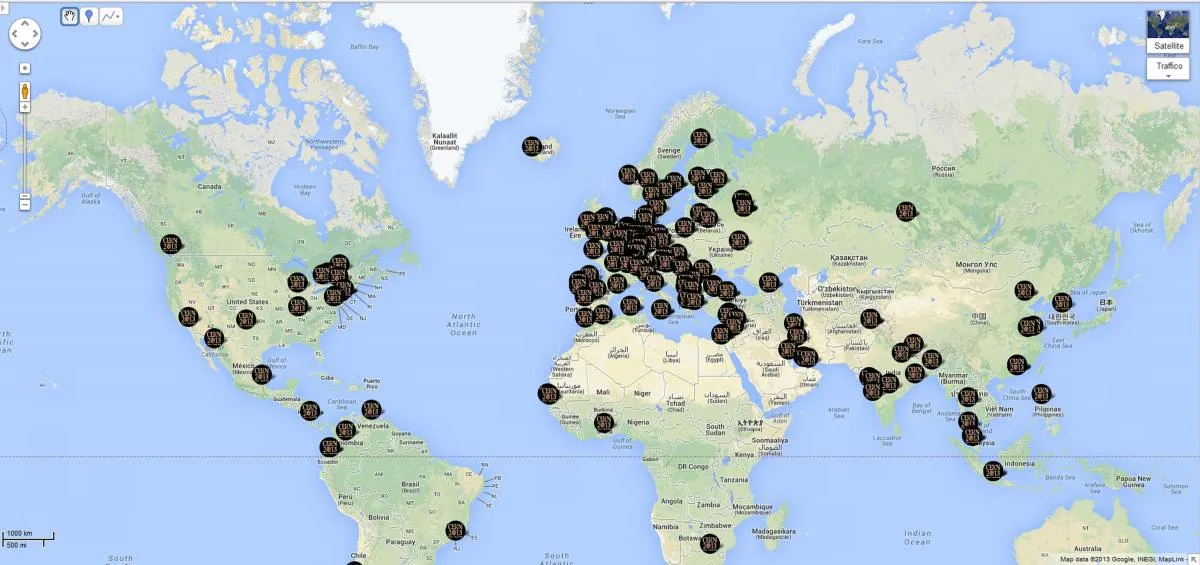
During the summer CERN turns into one of the most international and lively places you could ever imagine as hundrends of Summer Students arrive every year from all over the world. Students with different backgrounds spend a few weeks working with their supervisors on numerous topics in scientific research. Among this year's summer students you will meet an astronomer, a biochemist, a computational biologist and even an Olympic Winner! These are young scientists with an incredible amount of talent, intelligence and full of energy.
CERN summer students clearly have an eye for scientific research but also a sharp view that challenges what is often taken for granted.
Reflecting this unique experience in the issue of a newsletter, not to mention in an article, is not an easy task. However, we decided to give it a try and the results have been rewarding; more than 60 stories coming from both Member and Non-Member students are pinned on a world map of 2013 PH Summer Students*. Explore this interactive map and find out more about their experience as CERN summer students while you can also find links to their universities and more photos. You can also view the full map of 2013 CERN summer students here (please note that in this version students are grouped according to their nationalities).
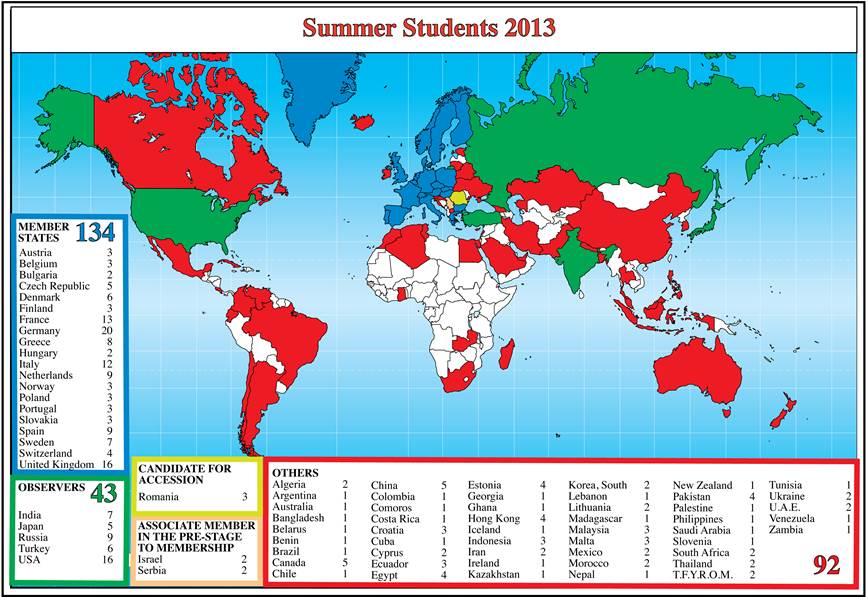
We feel indebted to Sharon Lynne Hobson, Laura Saulnier, Eva Tolosa and Anca Burghart for their kind support in this project. Moreover, special thanks goes to the students who participated in a mini editorial board that we formed for this Special Issue of the PH newsletter. They were a great source of inspiration and without their help we would have never succeeded in getting so many stories: Rodrigo Gaston Cortinas, Julia Gonski, Catherine Hsu, Antti Juhani Karjalainen, Ioannis Kiaras, Albert Guiterrez Mila, Silvia Manconi, Vasilis Nicolaou, Cristina Martin Perez, Maria Brigida Brunetti, Argyris Zardylis and Gudmundur Stefansson.
Many thanks to all the students who shared their experiences, shared their photos and kindly participated in this project. Finally, I am grateful to Vasilis Nicolaou, one of the hidden heroes behind this special issue; “writing code is like writing literature” as he often says.
Perhaps the best summary of the experience at the end of this project is described in the words that one of the students shared just after leaving CERN:
"Everything comes to an end so does this summer school for me. I learned a lot of things, physics, programming, astronomy, but the most important thing I realised was something very simple. CERN means nothing without the people working at it, I thought that the things that I will really miss will be the research at CERN and working with particle physics. But the truth is that I will really miss doing that with the people I met there. I will miss the long discussions in R1, chatting with people around the world, admiring the diversity of their culture! It was an amazing experience which I will never forget. I hope the best for all and I hope we meet again someday!". I hope that it won't be too long.
We selected a few stories to appear in this issue of our newsletter. We would love to add more but we thought that it is better for you to have a look on our map where there are more things to discover…
* Students are placed on the map based on the locations of their universities. The map shows only students enrolled in the PH department. You need to enable javascript in order to view this map correctly. We put an effort into achieving the maximum accuracy possible according to the coordinates of their universities. However this hasn’t been always possible due to certain limitations. Thank you for your understanding and we will keep working to fix any remaining issues.
New Staff members and fellows: January – March 2020
![BergaminG[3].png](https://ep-news-wp.web.cern.ch/wp-content/uploads/2026/06/BergaminG3.png.webp)
Gianmario Bergamin
I am an electronics engineer and I joined the EP-ESE-ME group at CERN as fellow in January 2020. As a digital designer, I work on the design of the CMS Outer Tracker Front-End ASICs continuing the work started during my master thesis. My role is to contribute to the development of next prototypes with particular emphasis on new Design For Testability solutions.
![Bonav[3].png](https://ep-news-wp.web.cern.ch/wp-content/uploads/2026/06/Bonav3.png.webp)
Matias Alejandro Bonaventura
As a Fellow for the data acquisition (DAQ) of the ATLAS experiment, I am working on the design of the future Storage Handler for run 4, a high-throughput distributed data storage. We have the challenging task of implementing a distributed storage that should cope with throughput of 7.8 TB/s with a writing rate of 1MHz. I finished my PhD in Computer Science on the simulation of data acquisition networks in the University of Buenos Aires. I have been contributing to the ATLAS DAQ since 2014 involved in network simulation and operation projects. Before, I have worked 6+ years as a software developer in different companies.
![Brenner[1]_1.png](https://ep-news-wp.web.cern.ch/wp-content/uploads/2026/06/Brenner1_1.png.webp)
Lydia Brenner
As a CERN research fellow, I will work on the ATLAS experiment and I will contribute to the final Run-2 luminosity calibration as well as on preparations for vdM scans in Run-3. I will work on the finalisation of the full Run-2 H->gamma gamma analysis, with responsibility for the unfolding/fitting framework. When this effort conclude I will continue to focus on Higgs properties measurements. I will continue as a member of the ATLAS statistics committee. Finally, I will contribute to the commissioning of the FASER tracking detector. As well as help with the analysis of the first physics data.
![Cristella[1]_2.png](https://ep-news-wp.web.cern.ch/wp-content/uploads/2026/06/Cristella1_2.png.webp)
Leonardo Cristella
I am an experimental particle physicist and I started a fellowship within the CMS experiment. I am involved in the High Granularity Calorimeter (HGCAL) project for the HL-LHC. During my Ph.D. at University of Bari I worked on data analysis, performing a search for tetra-quark particles in CMS. As a postDoc I joined the CRAB team, aiming at improving the efficiency of CMS distributed analysis jobs on the WLCG. My current focus is on the development of the HGCAL reconstruction towards its integration into the high-level trigger phase and the CMS global event description.
![Ducu[1]_0.png](https://ep-news-wp.web.cern.ch/wp-content/uploads/2026/06/Ducu1_0.png.webp)
Otilia Ducu
I recently integrated the ATLAS CERN team as a research fellow. I plan to continue to participate in searches for new physics with same-sign and multilepton final states, as I did before joining CERN. In parallel, I will contribute to the activities of the muon New Small Wheel CERN team to help preparing for Run-3. Later, I will also restart some performance studies for electrons or photons, a domain in which I was significantly involved during Run-2.
![Himm[1]_0.png](https://ep-news-wp.web.cern.ch/wp-content/uploads/2026/06/Himm1_0.png.webp)
Anja Himmerlich
I am a new fellow at CERN working in the EP-DT group in the SSD (Solid State Detector) laboratory. I will focus on the characterisation of radiation induced defects, that are leading to performance degradation in silicon detectors, by using defect spectroscopy measurements (e.g. DLTS – Deep Level Transient Spectroscopy and TSC – Thermally Stimulated Currents). Thereby, I will concentrate in particular on performance degradation of p-type silicon devices by acceptor removal effects. I performed my PhD studies at Technical University Ilmenau (Germany) focusing on the epitaxial growth and surface characterisation of III-nitride semiconductor materials.
![Rivera[1].png](https://ep-news-wp.web.cern.ch/wp-content/uploads/2026/06/Rivera1.png.webp)
Esteban Curras Rivera
Since 1st March I am member of the EP-DT group. One of my main tasks will be to participate in the EP-R&D Programme on Technologies for Future Experiments. In particular, I will be part of the WP1 that is called: Silicon Detectors. In this context, I will work with Michael Moll (my Fellow supervisor), Dominik Dannheim and Federico Ravotti in the “simulation and characterization of silicon detectors” and some collaboration too with Victor Coco in the topic of “hybrid pixel detectors”. More in detail, my work will focus on radiation damage characterization and the characterization infrastructure: with laser test stands, flexible r/o systems and defect characterization. Also, in collaboration with RD50, I will perform radiation-damage models for defects damage characterization and quantitative damage prediction for LGAD and p-type sensors.
![Fernande[1].png](https://ep-news-wp.web.cern.ch/wp-content/uploads/2026/06/Fernande1.png.webp)
Placido Fernandez
During my PhD I was involved with the LHCb upgrade for Run 3 where I developed and optimized Kalman filter software and tracking algorithms for different hardware architectures. My research focused on the application of high performance computing techniques for high-energy physics. After my PhD I joined the EP-LCD group, working on a framework for future experiments for CLIC, FCC, and SuperCharmTau factories.
![Haranko[1].png](https://ep-news-wp.web.cern.ch/wp-content/uploads/2026/06/Haranko1.png.webp)
Mykyta Haranko
I am a new fellow at CERN working on the Phase-2 upgrade of the CMS luminosity systems in the context of the BRIL project. In the scope of my PhD project at DESY (Hamburg), I have developed a test DAQ system for the Phase-2 upgrade of the CMS Outer Tracker. In my new role, I will apply the FPGA experience gained in the former project to integrate luminosity data processing functionality in the back-end systems of various upgraded CMS detectors and also contribute to the development of a new standalone luminosity detector for BRIL.
![Hasse[1].png](https://ep-news-wp.web.cern.ch/wp-content/uploads/2026/06/Hasse1.png.webp)
Christoph Hasse
Before my fellowship I was a CERN doctoral Student within the German Wolfgang-Gentner program. My thesis focused on developing new event reconstruction algorithms to enable the first stage of LHCb’s High Level Trigger (HTL) to process the expected event rate of 30MHz in run 3. During my fellowship I will continue this work and take part in the effort to improve the second stage of the trigger system as well as the following commissioning of the entire trigger system.
![Jacazio[1].png](https://ep-news-wp.web.cern.ch/wp-content/uploads/2026/06/Jacazio1.png.webp)
Nicolo Jacazio
I am CERN Fellow studying the production of light and heavy flavour hadron production in pp and heavy-ion collisions at the LHC. I have obtained my PhD in Physics a year ago at the University of Bologna. I am currently working in the ALICE experiment to develop the new software needed for physics analyses of the Run3 data. I have contributed to the ALICE TOF detector maintenance and upgrade. I am also carrying out the software development for Quality Control during data taking.
![James[1].png](https://ep-news-wp.web.cern.ch/wp-content/uploads/2026/06/James1.png.webp)
Thomas James
I have recently joined CERN EP-CMD as a fellow working on machine learning in FPGAs for the CMS level 1 trigger and 40 MHz data scouting. This project is in collaboration with CERN Openlab and Micron Technology, who are providing FPGA-based processing boards and deep learning accelerators. Previously I was a Postdoctoral researcher at Imperial College London, where I worked on the CMS level 1 track-trigger for the High Luminosity LHC, and the development of the tracker back end systems. My PhD focussed on an all-FPGA track finder demonstrator for CMS.
![Klein[1].png](https://ep-news-wp.web.cern.ch/wp-content/uploads/2026/06/Klein1.png.webp)
Jochen Klein
After an INFN fellowship at Torino, I returned to CERN as a staff member with the ALICE Collaboration in January 2020. As Upgrade Coordinator, my main focus is on preparing the ground for future extensions of the experiment for Run 4 and beyond. In addition, I am involved in the commissioning of detectors to be installed during the ongoing Long Shutdown, the development of the analysis framework, and the preparation for physics in Run 3.
![Kowalska[1].png](https://ep-news-wp.web.cern.ch/wp-content/uploads/2026/06/Kowalska1.png.webp)
Magdalena Kowalska
I have (re-)joined the Small and Medium Experiments (SME) Group as an experimental research physicist, after a year as a professor at the University of Geneva. I will continue working mostly at the ISOLDE facility, but will also explore synergies with other experimental programs at CERN, such as the AD. My research will focus on the use of radioactive nuclei in a variety of fields. I will continue my ERC Grant devoted to first biological applications of an ultrasensitive Nuclear Magnetic Resonance observed via beta-decay asymmetry. I will also search for New Physics by determining the Vud matrix element of the CKM matrix in the decay of spin-polarised nuclei.
![Laurelli[1].png](https://ep-news-wp.web.cern.ch/wp-content/uploads/2026/06/Laurelli1.png.webp)
Santeri Laurila
I am an experimental particle physicist from Finland, joining the EP-CMG group as a research fellow. For my PhD, I searched for charged Higgs bosons and worked for the CMS Level-1 trigger. This is an exciting time to come to CERN: we still have a lot to learn from Run-2 data, while preparations for Run 3 and HL-LHC are in full swing. I will work on Higgs measurements with “boosted” objects, squeezing the most out of the Run-2 data, and on the trigger side where new, clever triggering strategies enable us to broaden the physics reach of the experiment.
![Madsen[1].png](https://ep-news-wp.web.cern.ch/wp-content/uploads/2026/06/Madsen1.png.webp)
Jeppe Madsen
I am a new staff member working in the Medipix team as an electronics technical engineer. My main tasks will be wafer testing and providing support to users of the Medipix family of ASICS. I have a background in philosophy and political communication but later changed focus to work with electronics at the Niels Bohr Institute, where I completed my five-year internship to become a technical engineer. Before arriving at CERN, I was working with health science as a mass spectrometry specialist at a clinical proteomics research group in Copenhagen. Here I was focusing on instrumentation in the effort to bring LC/MS technology to the clinics.
![Mallem[1].png](https://ep-news-wp.web.cern.ch/wp-content/uploads/2026/06/Mallem1.png.webp)
Linda Mallem
I started my career as an executive assistant at the headquarters of large multinationals such as Carrefour, Areva and L’Oréal. In April 2018, I was hired as a temporary administrative assistant at the CERN Users’ Office, which lead to me applying for and being offered a staff position in January of this year. Navigating an international organization such as CERN feels natural to me and is consequently greatly rewarding. The Users’ Office is the first point of contact for CERN’s associated guest scientists (Users, COAS and VISC) and provides customer service to those coming to work in the field of experimental physics. We truly represent the face of CERN for this wide community (13 000 USERs from around 110 different nationalities and 76 different countries). If my main task is to ensure the respect of the contractual aspects of our guest scientists’ association with CERN, I also get to work on side projects. This year, I will focus on strengthening the relationship between the Users’ Office and the Service Desk. The project will involve providing the Service Desk with clear standard answers and generally expanding the Users’ Office existing offer of knowledge articles. I will do my best to ensure my contribution makes a difference to the User community, allowing them to work in the best conditions possible, whether on site or remotely, all the while honouring CERN’s core values.
![Mallios[1].png](https://ep-news-wp.web.cern.ch/wp-content/uploads/2026/06/Mallios1.png.webp)
Stavros Mallios
After finishing and successfully defending my thesis on firmware development for the Phase-2 CMS L1 trigger project, I was selected to work as a CERN senior fellow for the High Granularity Calorimeter (HGCAL). HGCAL is a new detector designed to meet the challenges of the High Luminosity LHC (HL-LHC). More specifically, I am working on developing firmware for the Data Acquisition system (DAQ) of the CMS HGCAL project. The HGCAL DAQ system interacts with the on-detector electronics of the calorimeter and sends the event data to the central data acquisition system of CMS. This task requires apart from firmware development, hardware work, as well as development of supporting software. The work is being supervised by Paschalis Vichoudis and in close collaboration with the head of the CMX electronics group David Barney.
![Marcon[1].png](https://ep-news-wp.web.cern.ch/wp-content/uploads/2026/06/Marcon1.png.webp)
Leonardo Marcon
I am Leonardo Marcon an Italian researcher with a Ph.D. in telecommunication engineering, and in particular in distributed optical sensing, achieved at University of Padova. I have started working at CERN as a Senior Fellow from March 1st 2020. My job here focus on improving, testing, and qualifying the drivers and optical transceivers of the optical channels deployed in accelerators and experiments, to increase their maximum data rate and make them more radiation tolerant. I will be working for the EP-ESE-BE section under the supervisor on Dr. Jan Troska.
![Pantaleo[1].png](https://ep-news-wp.web.cern.ch/wp-content/uploads/2026/06/Pantaleo1.png.webp)
Felice Pantaleo
I am an applied physicist who first arrived at CERN 10 years ago as a Summer Student. I joined the EP-CMG group and CMS first as Doctoral Student, then as Fellow and today as Staff member. I will work on the software reconstruction of the CMS Phase 2 high granularity endcap calorimeter using state-of-the-art heterogeneous computing, performance portability and machine learning techniques.
![Scarsella[1].png](https://ep-news-wp.web.cern.ch/wp-content/uploads/2026/06/Scarsella1.png.webp)
Carmelo Scarcella
I received my master’s degree in Electronic Engineering and Ph.D. from Politecnico di Milano. In September 2016 I joined as a fellow the EP-ESE Group at CERN, where I was involved in the development single-mode rad-hard optical links for particle accelerators in collaboration with the Beam Instrumentation Group. I am starting a new journey in the EP-ESE back-end Section where I will be working on the development of the next generation of radiation resistant data transmission systems for High Energy Physics, based on Silicon Photonics.
![Στιγμιότυπο%202020-03-27,%2023.55.00[1].png](https://ep-news-wp.web.cern.ch/wp-content/uploads/2026/06/Στιγμιότυπο202020-03-272023.55.001.png.webp)
Antonija Utrobicic
I am an experimental physicist with the main research interest in the field of gaseous particle detector systems. During my Ph.D. at the University of Zagreb, I was mainly engaged in the optimization of their performance and the research of the operational stability where I specialized effects of the electrical discharge propagation in a gas electron multiplier (GEM) detector. At CERN, I joined the Gaseous Detector Development (GDD) group as a fellow where I will work on an extension of a PICOSEC Micromegas detector to a multichannel system and continue the research of the Micro-Pattern Gaseous Detectors (MPGD) stability.
![Volkl[1].png](https://ep-news-wp.web.cern.ch/wp-content/uploads/2026/06/Volkl1.png.webp)
Valentin Volkl
I am a CERN fellow in the SFT group working on the Key4HEP project, i.e. software and simulations for Future Colliders. As a doctoral student I was already working on the Future Circular Collider Design Study, writing my thesis on track reconstruction with timing information in FCC-hh. This also gave me a strong sense of the importance of collaborations in High Energy Physics, especially in software, and organizations such as the HEP Software Foundation. So I am looking forward to continue working on the future of our field, now on the collaborative project Key4HEP with colleagues from CLIC, FCC and CEPC.