
The CERN – Latin America School
Each year CERN organizes a number of schools that give junior researchers the chance to study the latest research topics in High Energy Physics. Two Schools are held by CERN every year: namely the European School that is annually organized and another School that is organized successively in Latin America countries (in odd-number years) or in the Asia-Pacific region.
The CERN Schools of High-Energy Physics date back to the early 1960s. The first schools were organized in Switzerland near CERN, but soon they were held annually in other countries. Starting in 1970 some of the Schools were organized jointly with JINR, CERN’s sister organization in the Soviet Union. Since 1993 all of the European Schools have been organized in collaboration with JINR; a collaboration that exemplifies how a common interest in science can bring people from different countries together in order to work in harmony with the common goal of expanding human knowledge. This has always been the aim of the School; to bring together young physicists from many different countries and encourage them to work together during two intense weeks. Organizers make an effort to mix participants from different regions and promote cultural exchange, while special emphasis is placed on promoting informal interactions between the students and the staff of the School.
The idea of holding similar schools outside Europe dates back to the late 1990’s. After recognizing the strong interest of the Latin American countries in High Energy Physics, it became apparent that a school would encourage further participation in HEP Experiments. The aim was to prepare people for research in experimental high energy physics and help physicists who have previously undergone theory training to take a step towards experimental physics. Indeed, during the last few years, the Latin-American community has been growing and this is partly because of the support of HELEN and EPLANET programmes but also because several LA countries have joined CERN experiments. The schools hold a significant role in establishing some of these contacts.
The first Latin-American School was held in Brazil in 2001, with subsequent events in Mexico (2003), Argentina (2005), Chile (2007) and Colombia (2009). Typically there were about 50 student participants in these schools, compared to about 100 in the European Schools. More recently, the 2013 School was held in Arequipa and more than 65 students attended, selected from 130 applicants. Nick Ellis, director of the CERN Schools of Physics explains: “most of the applications were submitted by ideal candidates and making the selection proved to be a tough job”. An important criterion for the organizers is the applicant's potential to pursue a career in physics research, while the level of experience is also taken into account. It is often the case that candidates might benefit by waiting another two years until they are in a better position to decide their next research steps.
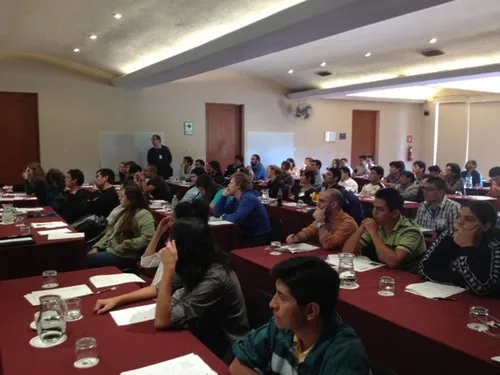
Students of the CERN-Latin American School attended a comprehensive programme of 32 lectures and five discussion sessions.
The scientific curriculum of the Schools consists of an intense programme of lectures that covers a lot of material in two weeks. Lectures are complemented by discussion sessions during the evening, where students are separated in small groups of 15 people, with each group having a discussion leader. Discussion groups are asked to select a published experimental paper and collaborate in order to understand the analysis and the interpretation of the results. Then, they are asked to sit together and present their paper to the other groups. "In the beginning people thought that the project would not work because we do not tell the students what exactly they should do but this is exactly the point; to allow them to come up with their own decisions” says Ellis. The programme of the School also includes a student poster session, where many of the students presented their own research work to other participants, including teachers and the organizers. Thus, students have the opportunity to discuss their own work with some of the leading experts in the field and develop their skills in teamwork in a context very relevant to their future work as researchers.
BROKEN IMAGE NOT MOVED (drupal url : https://ep-news.web.cern.ch//content/cern-latin-america-school)
A photo from the student project session: students were asked to to conduct an in-depth study of a published paper and come with their own questions.
BROKEN IMAGE NOT MOVED (drupal url : https://ep-news.web.cern.ch//content/cern-latin-america-school)
Students presented their results in poster sessions during the CLASHEP 2013
This was the first time that CLASHEP was hosted in Peru – a choice that reflects the increasing development of high-energy physics in the country. PUCP in Peru has been collaborating with CERN for many years. It dates back to 2004, when Gerardo Herrera proposed to Alberto Gago to work on the simulation of the VOA, and became more intense since 2006 within the context of the HELEN project. PUCP has been a full member of ALICE since 2009. Alberto Gago also got in touch with other universities in Peru, namely UNI and UNAS that participated in the local organizing committee and helped with the organization of the 2013 School. Organizing a School means a lot of work that usually has to start more than a year ahead and involves a lot of administrative work and one should acknowledge the invaluable help of Helen Haller and Kate Ross.
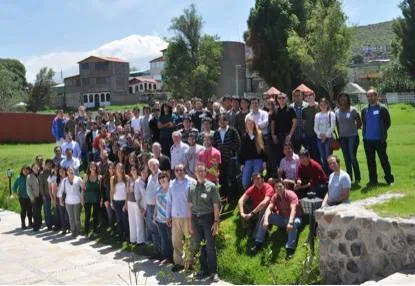
The participants of the CLASHEP 2013.
"The financial contribution from the organizing country has been important, as it allowed subsidizing students from Latin-American countries to attend the School" adds Martijn Mulders, the Deputy Director of the CERN Schools of Physics. "This complements the regular sponsorship that comes from CERN, from the Spanish Funding Agency CIEMAT and from RENAFAE in Brazil", he continues.
CLASHEP 2013 supports the development of the High-Energy Physics community in Peru and the organizers look forward to receiving more applications from Peruvian physicists for the next CERN – Latin American School that will take place in 2015. It turns out that many participants of the CERN School pursue a career in Experimental HEP and they continue their careers as postdocs and junior researchers. This is one of the aims of the School, namely to support the development of HEP physics communities in the hosting countries and help train the next generation of physicists in the field of high energy physics.
The CERN Latin American School is jointly organized by: the European Laboratory for Particle Physics (CERN), Geneva, Switzerland; CIEMAT, Research Organization of the Spanish Ministry of Education and Science; RENAFAE, National Network for High Energy Physics, Brazil. The local organizing committee consisted of our colleagues from PUCP as well as from UNSA and UNI, namely: Hernán Castillo (PUCP), David Pacheco (UNSA), Rolando Perca (UNSA), Orlando Pereyra (UNI) and Javier Solano (UNI).