
LHC successfully completes proton run during Run 2
The Large Hadron Collider (LHC) has successfully completed its planned proton run for 2015, delivering the equivalent of about 400 trillion (1012) proton-proton collisions. The year began with an intense phase of commissioning using cosmic-ray data and the first proton–proton collisions that allowed physicists to test the trigger and detector systems, as well as align the tracking devices.
On 20 May at around 10.30 pm, protons collided in the LHC at 13 TeV for the first time. These test collisions aimed to set up various systems, in particular the collimators, and beams were "de-squeezed" to become larger at the interaction points than during standard operation. The test was organised in preparation for a special run for the LHCf and for luminosity calibration measurements by the experiments, where the beams are scanned across each other—the so-called "van der Meer scans". Progress was also made on the beam intensity front, with up to 50 nominal bunches per beam brought into stable beams by mid-June. There were some concerns that an unidentified obstacle in the beam pipe of a dipole in sector 8-1 could be affected by the higher beam currents. This proved not to be the case—at least so far. No unusual beam losses were observed at the location of the obstacle, and the steps towards the first sustained physics run continued.
BROKEN IMAGE NOT MOVED (drupal url : https://ep-news.web.cern.ch//content/lhc-successfully-completes-proton-run-during-run-2)
The collection of physics data in LHC Run 2 started in June, with proton–proton collisions at a centre-of-mass energy of 13 TeV. The eight weeks of beam commissioning had seen a sustained effort by many teams working nights, weekends, and holidays to push the programme through. Their work involved optics measurements and corrections, injection and beam-dump set-up, collimation set-up, wrestling with various types of beam instrumentation, optimization of the magnetic model, magnet aperture measurements, etc. In addition, the operations team tackled the intricacies of manipulating the beams through the various steps, from injection through ramp and squeeze to collision. All of this was backed up by the full validation of the various components of the machine-protection system by the groups concerned. The execution of the programme was also made possible by sufficient machine availability and the support of other teams working on the injector complex, cryogenics, survey, technical infrastructure, access, and radiation protection.
Achieving the first stable beams was an important step for LHC Run 2, but there is still some way to go before this year’s target of around 2500 bunches per beam is achieved. In the beginning of September, the machine was switched off for its second scheduled technical stop since starting to run at the new high energy of 6.5 teraelectronvolts (TeV) per beam. These regular stops allowed engineers and technicians to maintain the machine and ensure that all its components are working well.
The work focussed on two main tasks: installing four beam-gas vertex detectors at Point 4 and replacing more than 1000 electronic circuit boards in the accelerator's quench protection system (QPS). The job of the QPS is to monitor the LHC's superconducting magnets for tiny changes in voltage. These magnets operate at very low temperatures—1.9 K or -271.3°C—and even a tiny amount of energy released for any reason inside a magnet can warm its superconducting materials above the critical temperature, causing a loss of superconductivity. When this happens, the current has to be safely extracted in a very short time. Magnet protection in case of quenches is a crucial part of the design of the LHC’s magnetic system, and the electronic cards are in effect the eyes and ears of the quench protection system. This sensitivity is a limiting factor for the intensity of the beam in the LHC—the chips on the cards stop working when a certain number of bunches of protons are injected and accelerated to the top energy.
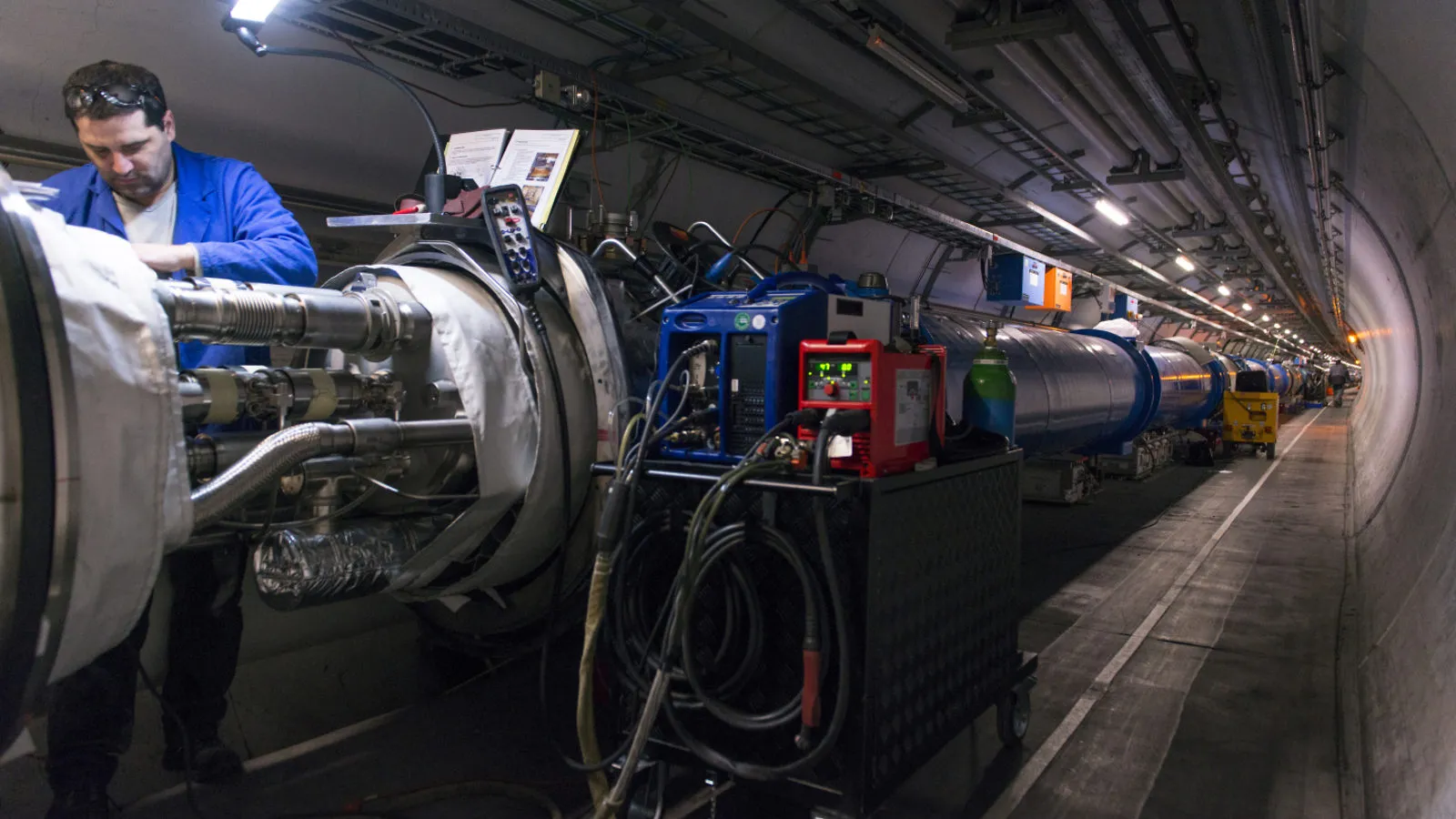
The replacement of more than 1000 cards by the LHC team and a series of electrical quality and powering tests allowed higher intensities.
Near the end of the technical stop, the machine could deliver 1000 bunches per beam. The team is currently increasing the number of proton bunches, step by step. At each stage, the machine must run for a total of 20 hours, providing stable beams for the experiments, while the operators check that all systems are working properly before stepping up the number of bunches again. The target for this year is about 2300 bunches, spaced by 25 ns. The new energy regime highlighted several issues for the Operations team, including increased electron-cloud effects at high beam intensities, and falling particles of dust inside the beam-pipe causing premature beam dumps. Thanks to the hard efforts of all the teams, LHC passed a new milestone and physicists are already working with the first set of data. However, there is still some time until the LHC starts delivering the desired integrated luminosity to the experiments.
Following the restart after September's technical stop, the LHC will start colliding lead ions, allowing the experiments to further study the quark-gluon plasma. This run will provide more statistics while the upgrade during LS1 improved the detector's efficiency and data triggering and recording capabilities. The new heavy-ion run is also a challenge for LHCb that is now joining the study of lead-lead collisions.
The LHC and the experiments will run around the clock for the next three years, opening up a new frontier in high-energy particle physics. Though 2015 may have been a short year for physics, we laid the foundations for 2016 and the rest of Run 2. Following the lessons from the first proton run at 13 TeV, engineers and technicians are now working to prepare the LHC for the first heavy-ion run that will take place during the last weeks of 2015.