
Tag: ALICE
-
Strangess enhancement observed in proton collisions
Strangess enhancement observed in proton collisions In a paper published last month in Nature Physics, the ALICE collaboration reports that proton collisions sometimes present similar patterns to those observed in the collisions of heavy nuclei. This behaviour was spotted through observation of strange hadrons in certain proton collisions in which a large number of particles
-

A Moriond Retrospective: New Results from the LHC Experiments
A Moriond Retrospective: New Results from the LHC Experiments Every March, particle physicists around the world take two weeks to promote results, share opinions and do a bit of skiing in-between. This is the Moriond tradition and the 52nd iteration of the conference took place this year in La Thuile, Italy. Each of the four
-
Wealth of new results in Quark Matter 2017
Wealth of new results in Quark Matter 2017 BROKEN IMAGE NOT MOVED (drupal url : https://ep-news.web.cern.ch//content/wealth-new-results-quark-matter-2017) Last month, the LHC experiment collaborations presented their latest results at the Quark Matter 2017 conference on how matter behaved in the very early moments of the universe. The programme includes a plethora of presentations on a variety of
-
An ambitious p-Pb data taking campaign just came to an end
An ambitious p-Pb data taking campaign just came to an end These asymmetric collisions were originally meant as a benchmark to control for background effects unrelated to the production of a quark-gluon plasma, expected in Pb-Pb collisions simply due to the use of Pb nuclei instead of protons in the collisions. Distinguishing the two classes
-
LHC experiments present latest results in ICHEP16
LHC experiments present latest results in ICHEP16 BROKEN IMAGE NOT MOVED (drupal url : https://ep-news.web.cern.ch//content/lhc-experiments-present-latest-results-ichep16) New results from the LHC experiments were presented during the 38th International Conference on High Energy Physics (ICHEP 2016) that took place in Chicago, USA. The collaborations of the LHC experiments can now dive in and explore at the new
-
LHC Restart 2016
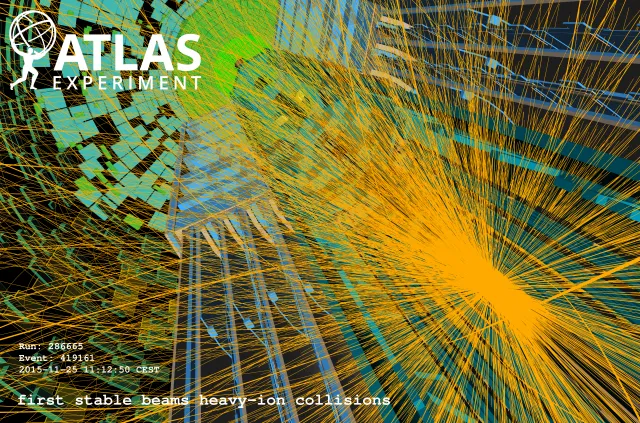
LHC Restart 2016 The Large Hadron Collider (LHC) and its experiments are back in action, now taking physics data at 13TeV. The goal is to improve our understanding of fundamental physics which ulitmately in decades to come can drive innovation and inventions by researchers in other fields. The Higgs was the last piece of the
-
ATLAS and ALICE PhD Awards
ATLAS and ALICE PhD Awards Two of the LHC experiments, ATLAS and ALICE, recently announced winners of the “ATLAS PhD Grant” and “ALICE Thesis Award” schemes. The prizes aim to foster healthy competition between young members of the two collaborators and acknowledge the hard efforts of the winners but also of those who were considered
-
Exit protons, enter ions
Exit protons, enter ions The 2015 LHC proton run, the first after the long shutdown 1, ended last week with a good performance of the LHC given the challenges of running at the new collision energy of 13 TeV. The new energy regime brought up several issues such as increased electron-cloud effects at high beam
-
A new energy frontier for heavy ions
A new energy frontier for heavy ions Although they lack the fundamental significance of the constants of Nature, powers of 10 have symbolic importance in human culture. Attaining the age of 100 years is rare enough to be celebrated in many ways around the world. We regularly mark the 100th anniversaries of historical events. A
-
LHC experiments upgraded trigger plans
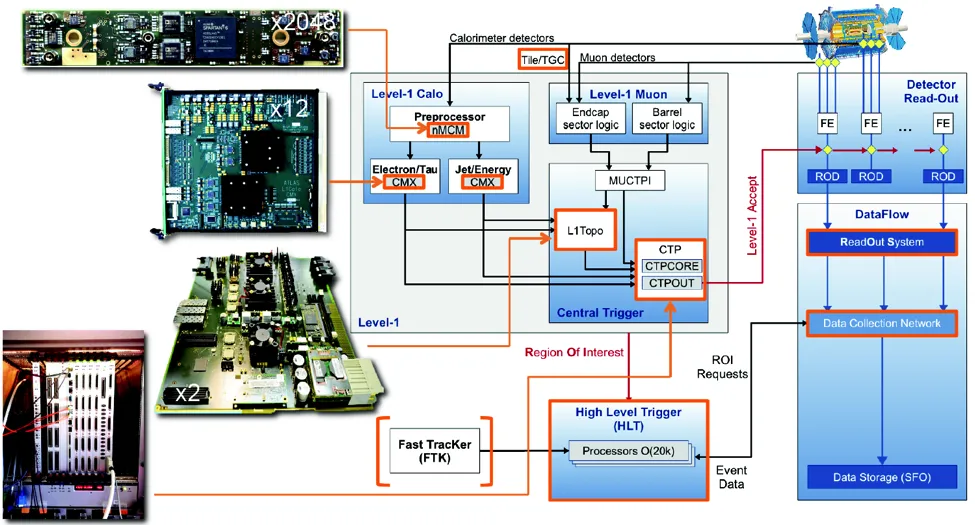
LHC experiments upgraded trigger plans As the LHC prepares for higher energies and luminosities all four experiments have upgraded their triggering to record data more efficiently and make sure that their detectors are ready to find evidence for new physics. The trigger teams from the experiments describe the changes made between Run1 and Run 2
