
TEST-FCCPH-29062025
FCC Week 2025: Advancing the Frontier of Particle Physics
As the FCC Week 2025 concluded in Vienna, Jan Eysermans delivered a summary of the physics prospects of the Future Circular Collider (FCC) integrated programme. The closing physics summary showcased the powerful case for the FCC-ee and FCC-hh as a unified strategy to deepen our understanding of the Standard Model and explore new physics at the energy and precision frontiers. With the release of the Feasibility Study Report (FSR) and the submission of several key summary documents as input to the next European Strategy for Particle Physics Update (EPPSU) in 2026, the FCC initiative is now moving decisively from conceptual design into concrete planning. For further details, see the FCC submissions to the EPPSU.
Initiated in response to the 2020 European Strategy for Particle Physics, the FCC Feasibility Study consolidates the CDR groundwork for a next-generation research infrastructure centered on a circular electron-positron collider (FCC-ee), followed by a hadron collider (FCC-hh) in the same tunnel. The report confirms the FCC as the strategic programme for European and global high-energy physics beyond the HL-LHC era.

Overview of the possible centre-of-mass energies for a full exploration programme at the FCC-ee as discussed in the FCC feasibility study (Image: FCC Feasibility Study)
The FCC’s Two-Pronged Approach to Higgs Physics
Higgs physics is one of the important aspects of the FCC’s scientific programme. Eysermans emphasised that only the integrated FCC approach can deliver the precision needed to fully explore Higgs boson properties. The electron–positron phase, FCC-ee, is essential for achieving sub-percent measurements of hadronic Higgs couplings, including sensitivity to the elusive Higgs–strange coupling. This is accomplished through complementary measurements at centre-of-mass energies of 240 and 365 GeV, where Higgsstrahlung and vector boson fusion processes dominate, together enabling a remarkably precise characterisation of the Higgs sector with nearly 3 million Higgs bosons produced. Crucially, FCC-ee also allows for a model-independent determination of the Higgs couplings to the Z and the W, which is a prerequisite for extracting absolute coupling strengths and total Higgs decay width — something not achievable at hadron colliders. With the precise measurement of the production cross sections at the two centre-of-mass energies, FCC-ee gives access to the Higgs self coupling with a precision of 27% (down to 15% when combined with HL-LHC) via loop effects. The FCC-hh phase complements this by accessing rare Higgs decays and, more significantly, by measuring the Higgs self-coupling with a precision improved from ~26% at the HL-LHC to just 2–3%. This level of precision has direct implications for theoretical models addressing the nature of electroweak symmetry breaking, shedding light on the structure and stability of the Higgs potential. It may ultimately reveal whether the Higgs boson is truly elementary or a composite state, as predicted in scenarios such as composite Higgs models or solutions to the hierarchy problem.
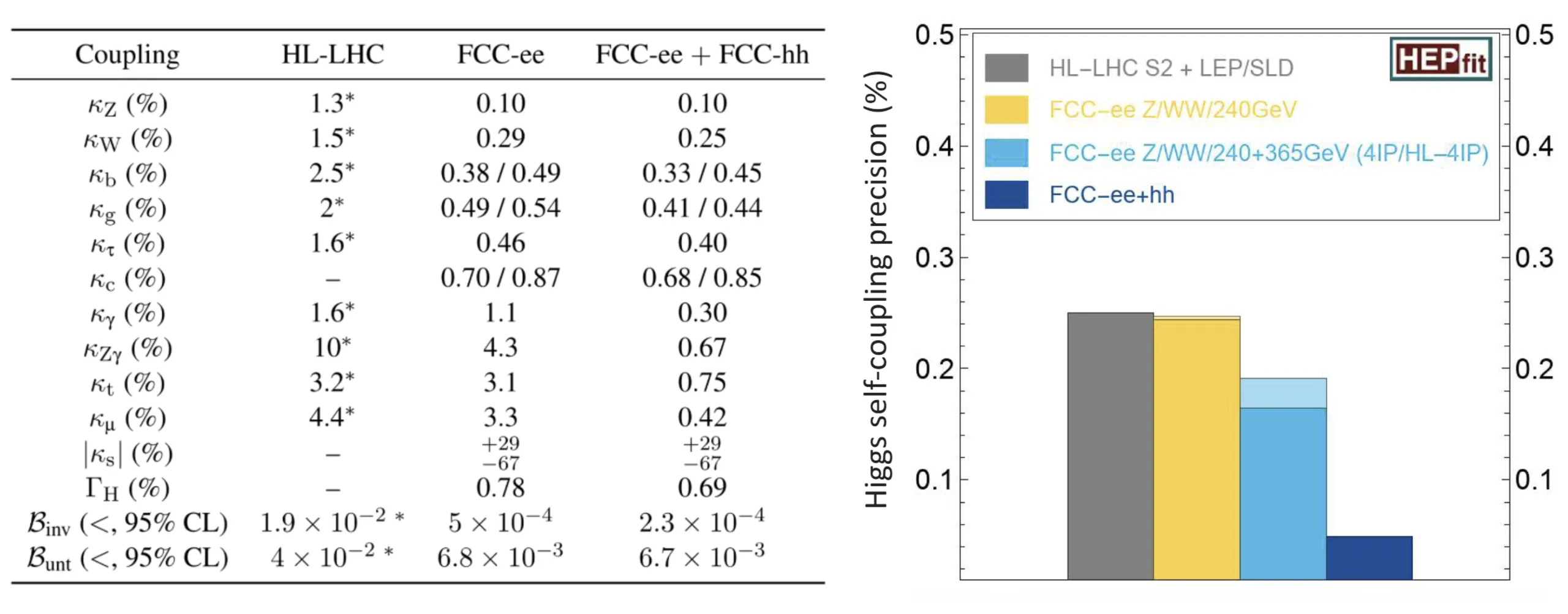
The left panel shows the projected precision on the Higgs couplings at FCC-ee and combined with FCC-hh, compared to the HL-LHC projections. Similarly, the projected precision on the self-coupling at the HL-LHC, FCC-ee, FCC-hh, and combinations is shown on the right panel. While the HL-LHC aims for a precision of around 26%, this improves to 15% with FCC-ee. The integrated FCC-ee/hh programme improves this dramatically to 2–3%, enabling stringent tests of the Higgs potential (Image: FCC Feasibility Study).
Physics beyond Higgs at FCC-ee
The FCC-ee is far more than a Higgs factory. Compared to LEP, FCC-ee will collect datasets several orders of magnitude larger at the Z pole and the WW threshold, fundamentally transforming how we test the Standard Model. During its Tera-Z and WW threshold phases, the collider will produce over 6×10¹² Z bosons and approximately 5×10⁷ W-boson pairs at the WW threshold in just a few years of data taking. These data will enable electroweak observables to be measured with up to three orders of magnitude greater precision. A complementary high-precision scan at the top–antitop threshold, producing 2×10⁶ top-quark pairs, will provide accurate determinations of the top-quark mass, width and electroweak couplings — key parameters that are notoriously difficult to extract at hadron colliders. Meeting these ambitious goals requires stringent control of experimental systematic uncertainties and biases, including beam energy calibration with a precision better than 100 keV, as well as equally precise theoretical predictions and simulation tools.

Predicted WbWb total cross section near the top–antitop production threshold at the FCC-ee, illustrating the impact of successive theoretical refinements. The left panel compares the pure N³LO QCD prediction with corrections from Initial-State Radiation (ISR) and Beam Energy Spread (BES), highlighting their significant impact near threshold. The right panel contrasts results at different perturbative orders (NLO, NNLO, N³LO) including ISR and BES effects, with vertical dashed lines indicating the validity range of the NRQCD framework. These calculations form the basis for high-precision top-quark mass measurements at FCC-ee via a threshold scan, exploiting the sharp rise in cross section to achieve sub-30 MeV precision (Image: FCC Feasibility Study)
The Tera-Z run will deliver a much larger sample of b, c and tau decays than foreseen at the Belle-II experiment, 10⁵ times larger than at LEP, and in a much cleaner analysis environment than is available at the HL-LHC. This will enable precision studies of rare flavour transitions such as b→s and b→𝜏, and CP violation in the heavy quark sector, offering complementary probes of new physics alongside direct searches. FCC-ee will also allow sensitive tests of lepton flavour universality and violation, tau lifetime and exotic decays, and enable the extraction of key flavour parameters — including CKM matrix elements — with unprecedented accuracy. With these capabilities, FCC-ee is poised to become a cornerstone of precision particle physics.
Beyond precision, FCC-ee’s clean experimental environment and high luminosity provide unique sensitivity to physics beyond the Standard Model. This includes the potential discovery of heavy neutral leptons, long-lived particles, axion-like particles, and dark photons — many of which lie beyond the reach of the HL-LHC. At the core of the FCC’s physics interpretation is the Standard Model Effective Field Theory (SMEFT), a powerful framework that encodes deviations from the Standard Model in terms of higher-dimensional operators. With FCC-ee data, it becomes possible to constrain many such operators, probing new physics at scales up to ~100 TeV. This makes FCC-ee a unique and versatile tool for exploring some of the most profound open questions in fundamental physics.

Projected exclusion limits on the mass scale of new tree-level matched vector bosons in the EFT framework, based on different FCC-ee running scenarios and theoretical assumptions. The combination of FCC-ee energy stages (91–365 GeV) leads to dramatic improvements in sensitivity, reaching multi-TeV scales well beyond current HL-LHC capabilities. This highlights the FCC-ee’s unique potential to constrain new physics indirectly through precision measurements, probing beyond-Standard-Model scenarios that remain inaccessible to direct searches (Image: FCC Feasibility Study)
Detector and Software Readiness
Achieving this ambitious programme demands highly optimised detectors, analysis tools, and software frameworks. As demonstrated during the FCC Week, simulation efforts — from fast parametric approaches to full GEANT-based models — are advancing rapidly, supported by the evolving Key4hep software suite. This common infrastructure is enabling an increasingly unified development environment. Advanced machine learning techniques now play a growing role in detector optimisation, flavour tagging, and event reconstruction, significantly accelerating the turnaround time for detector studies and design iterations.
The next phase will focus on defining the final detector requirements through full simulation studies across different detector benchmarks. This effort includes detailed treatment of beam-induced backgrounds, geometric acceptance, and calibration strategies, as well as close feedback loops between simulation and detector engineering. This work will result in the elaboration of at least four detector concepts tailored to meet the FCC-ee physics performance goals.
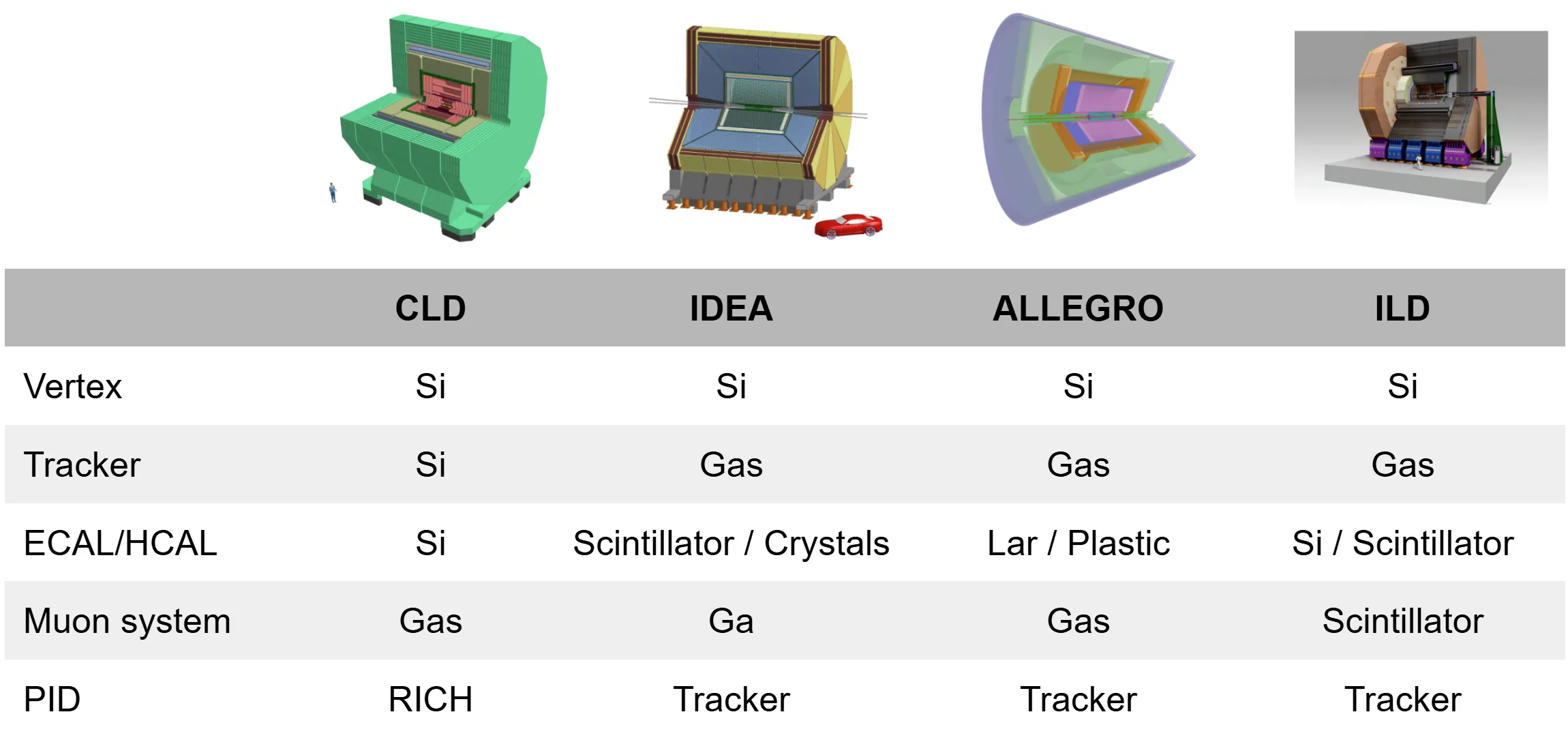
Overview of detector concepts under study for FCC-ee, as implemented within the Key4HEP software framework. The table compares key sub-detector technologies under consideration in the CLD, IDEA, ALLEGRO, and ILD concepts, including vertexing, tracking, calorimetry (ECAL/HCAL), muon systems, and particle identification (PID). Differences in tracker technology (silicon vs. gas), calorimeter materials, and magnetic field strengths (ranging from 2T to 3.5T) reflect diverse optimization strategies for performance, cost, and physics goals. These concepts serve as inputs for realistic simulation and reconstruction studies essential to evaluating FCC-ee’s physics reach (Image: FCC Feasibility Study)
A Clear Path Forward
The FCC Week 2025 marked a consolidation of years of work by the global FCC community. With the Feasibility Study Report complete, the focus now shifts to interpreting physics performance across detector concepts, consolidating systematic uncertainties, and finalising the physics case to support future decision-making.
The FCC integrated programme represents a bold and coherent programme for the future of high-energy physics. It stands not only as a bridge beyond the LHC, but as a precision instrument capable of revealing the structure of the fundamental forces — and perhaps, signs of new ones. As the FCC community moves from feasibility to preparation, this marks not an end, but a new beginning in our collective journey to explore the frontiers of particle physics.