
Tag: FUTURE COLLIDERS
-
LHC community prepares the High Luminosity Upgrades
LHC community prepares the High Luminosity Upgrades With the approval of the CERN Council in June 2016, the LHC is now moving toward execution of the High Luminosity upgrades. As well, after the first step of approval by scientific committees at the end of 2015, the ATLAS and CMS collaborations were encouraged by the Resource
-
Physics Beyond Colliders kickoff workshop
Physics Beyond Colliders kickoff workshop Recent results from the LHC shows that that the Standard Model works with a remarkable accuracy within the presently accessible energy range. However there is now overwhelming evidence for the existence of Dark Matter; a component of our Universe not described by the Standard Model. On the other hand, the
-
Physics at 100 TeV
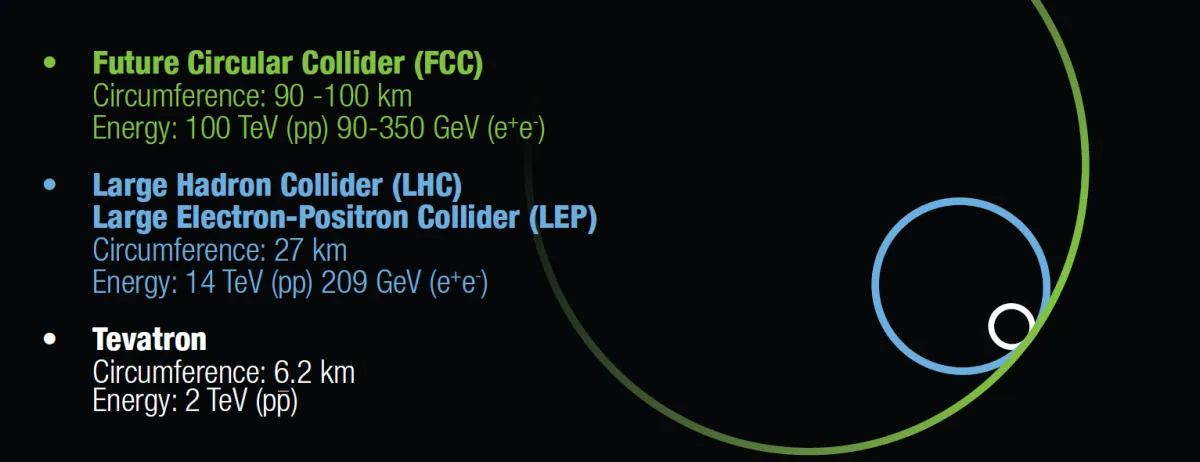
Physics at 100 TeV A report discussing the opportunities for physics discoveries with a future 100 TeV hadron circular collider was presented earlier this summer during the 2016 FCC Week. A future hadron-hadron collider machine will be able to cover previously unexplored territory at energies never before reached in a laboratory environment. Standard Model calculations
-
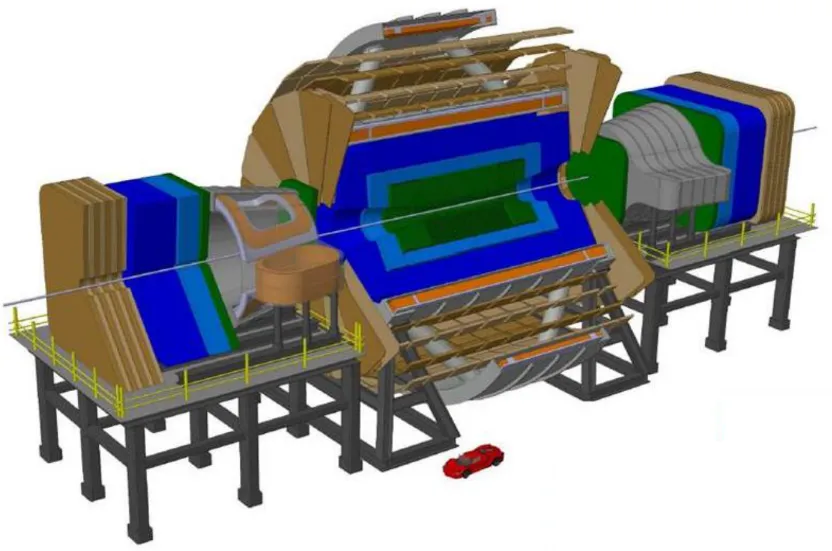
Design study of a twin solenoid and dipoles detector magnet system for the FCC study
Design study of a twin solenoid and dipoles detector magnet system for the FCC study The Future Circular Collider study for hadron-hadron collisions (FCC-hh) foresees a collision energy of 100 TeV, which is about 7 times higher than the LHC. For the detectors this means that in order to determine the properties of the particles
-
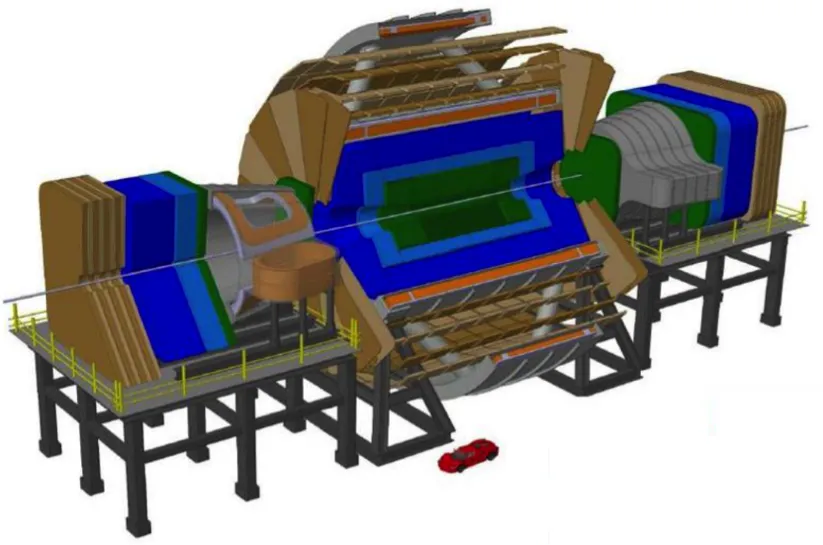
Design of Twin Solenoid & Dipoles Detector Magnet System for the Future Circular Collider
Design of Twin Solenoid & Dipoles Detector Magnet System for the Future Circular Collider The Future Circular Collider study for hadron-hadron collisions/collider (FCC-hh) foresees a collision energy of 100 TeV, which is about 7 times higher than the LHC. For the detectors this means that in order to determine the properties of the particles the
-
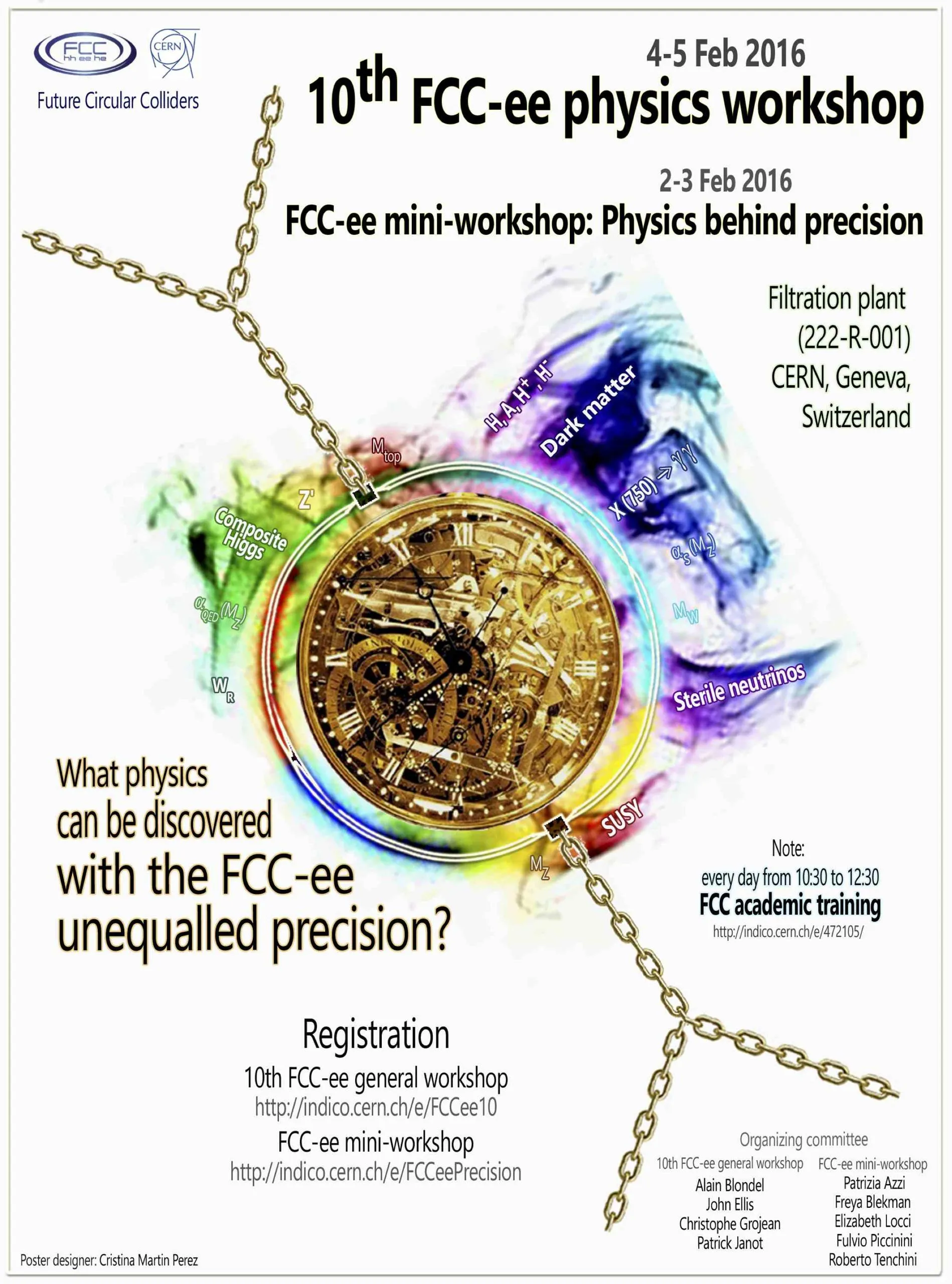
FCC-ee physics workshops at CERN
FCC-ee physics workshops at CERN The design study of the Future Circular Colliders (FCC) was initiated at the beginning of 2014, to identify post-LHC accelerator projects at CERN. The study has an emphasis on proton-proton (FCC-hh) and electron-positron (FCC-ee) colliders, and includes the design and optimization of detectors that would comply with the physics programme
-

AWAKE, an accelerator R&D experiment.
AWAKE, an accelerator R&D experiment. BROKEN IMAGE NOT MOVED (drupal url : https://ep-news.web.cern.ch//content/awake-accelerator-rd-experiment) AWAKE is an accelerator R&D experiment. In the coming years the AWAKE experiment should pave the way to understanding the physics and potential of proton-driven plasma wakefield acceleration for future accelerators. Over the last fifty years, accelerators of ever increasing energy have
-
A highlight from the CLIC annual workshop: an update to the baselining strategy
A highlight from the CLIC annual workshop: an update to the baselining strategy The Compact Linear Collider (CLIC) is a proposed e+e– collider to be built at CERN in order to serve the needs of the particle physics community beyond the high-luminosity LHC. The accelerator is foreseen to be built in several stages, allowing lower-energy
-
FCC-hh baseline layout and parameter set
FCC-hh baseline layout and parameter set The core of the Future Circular Collider (FCC) project is a hadron collider called “FCC-hh” which aims at colliding proton beams with a centre of mass energy of 100 TeV – more than seven times the energy that can be reached in the LHC. BROKEN IMAGE NOT MOVED (drupal
-
AWAKE starts installation
AWAKE starts installation On 18 September, the CERN council approved a boost in funding for a planned experiment called the Advanced Wakefield Experiment, or AWAKE. AWAKE is a proof-of-principle experiment, whose aim is to use protons to generate powerful wakefields, accelerating an electron beam. With accelerator gradients hundreds of times higher than those used in